
Between May 1 -3, Washington hosted Word Press Freedom Day celebrations. The event brought scores of journalists from around the world together to discuss the ‘new frontiers’ of the media. Participants from Malaysia to Colombia gathered to exchange ideas on topics such as social media, cyber-censorship and online investigation. Which is all fine and good.
On the surface this event seemed beneficial, but the event was built on four outdated assumptions which made most of the on-stage discussion pointless.
Assumption #1: We are the free world, so do what we tell you.
During the closing ceremony, UNESCO director Irina Bokova said that she “couldn’t think of a better place” to host the World Press Freedom Day. That would make sense if the United States topped press freedom rankings – but according to Freedom House’s 2011 Press index the US ranks 17, and in the Reporters Without Borders 2010 rankings, it comes in at number 20. Ms. Bokova should have considered Finland as a hosting country, as it’s the clear front runner.
In a more disturbing tone, delegates were reminded almost hourly of journalism’s death toll, yet no one mentioned that the US Army rules of engagement allows killing journalists with complete impunity. In fact, the US was responsible for at least 3% of all journalists’ deaths in 2007.
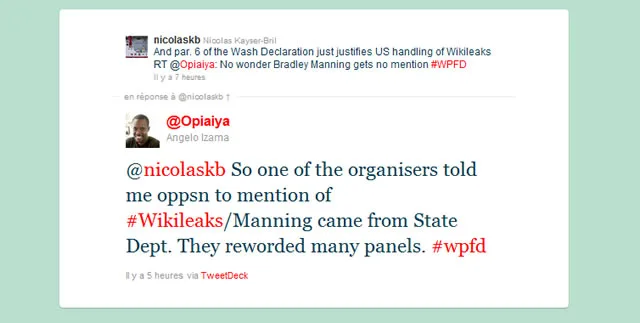
The Americans also poorly handled the situation concerning Wikileaks’ Cablegate leak, as it was considered a taboo topic. Organizers were allegedly told by the US State Department, a co-sponsor of the event, not to mention the whistle-blowing organization’s name. When asked to comment, organizers declined to answer. The delegates were asked to sign a document called the “Washington Declaration,” which in paragraph 6 states there are “legitimate” reasons for restricting free speech. This implies that the Obama Administration’s reaction to Cablegate was justified, such as when the State Department pressured service providers such as Amazon (which denies this) and Paypal into blocking access to Wikileaks. Despite fierce debate over this paragraph, organizers did not change the wording – citing the fight against child pornography as an example of legitimate restriction on free speech.
American self-righteousness was fatal to the conference’s credibility. The event was more about endorsing a US-centered vision of freedom of the press than discussing it.
Assumption #2: We have to help them reach our standards.
Feeling that they have achieved the highest form of free speech standards, several American delegates acted as if it was their duty to spread their vision abroad. Training in journalism and ethics as well as providing aid for the media’s infrastructure were considered by many organizers an instrumental means of media development.
Interestingly enough, many delegates I talked to believed this approach was hindering entrepreneurship and stifling innovation. A Palestinian media entrepreneur observed that direct aid fosters a culture of laziness. Journalists from Zimbabwe also indicated that donors might disproportionately help a single media in a region, so that smaller, more local initiatives are squeezed out of the market by an artificially large player.
The training programs offered were also brushed off as a superfluous expenditure. Premesh Chandran, CEO of Malaysiakini.com, argued that the training aspect was excessive. Philip de Wet, deputy editor of The Daily Maverick, insisted that they had plenty of well-prepared journalists and were only lacking the cash to hire them. Yet there is a lack of training in management techniques, added a delegate from Burundi.
The US is still committed to disseminating a journalism model that has failed on its own territory. By claiming it is self-evident that American journalism as the highest form in the profession, the US is ensuring that their initiatives towards creating freedom of information abroad remains useless.
Assumption #3: Journalists are key to freedom of expression.
World Press Freedom Day was celebrated by remembering all the journalists who lost their lives while reporting in conflict zones. This prompted some organizers to state that journalists were the only ones able to provide quality content. Joergen Ejboel, chairman of the board JP-Politikens Hus, a Danish publisher, said that journalists were needed to sort “rubbish” from the facts. Certainly he did not have in mind this brilliant piece by one of his newspapers, Ekstra Bladet, explaining how a former Playboy model was found mummified in her house.
A major problem in understanding the dynamics of quality content production remains in the equation between journalism and freedom of expression. Most journalists work for outlets, such as specialized magazines or non-investigative newspapers, which do not maximize freedom of expression. Conversely, many of those who do are not journalists. Aid workers fatalities data show the risks NGO personnel take when bringing back information from the ground. Bloggers and Facebook users, whether in Russia, Syria or the US, are regularly threatened, beaten or arrested because of content posted online.
As long as journalists are perceived as the only guardians of freedom of expression, efforts made to protect this freedom only through journalists will have minimal impact.
Assumption #4: Internet penetration must reach a critical point before having an impact.
The rationale behind several panels was that Internet penetration was often too low to make a difference. This implies that changes that are considered Internet-driven in countries with relatively low penetration (e.g. the Tunisian and Egyptian revolutions) must have originated elsewhere, or was only relevant to a minority of urban, educated youth.
Contrary to this preconceived idea, many delegates from regions with very low Internet presence were adamant that the web could make a difference in any conditions. Gregory Shvedov, editor-in-chief of the Caucasian Knot, explained that user-generated videos had a huge impact in Chechnya, despite single-digit penetration rates. He mentioned that the content shared online is so radically different from what people hear on the radio that it sticks in their mind.
Content and movements that originated online can also be covered in the traditional media and gain traction afterward. Sami Ben Gharbia, cofounder of Tunisian website Nawaat, explained that Al Jazeera reporters could get unique witness reports over the Internet that were then broadcast on the satellite channel.
—
Photo Credits: Flickr CC arnoKath and Phreak 2.0
💬 Discussion
No comments yet. Be the first to comment!