The people of Iran have the admiration of Anonymous and the entire world… As International Worker’s Day dawns, Anonymous stands with you.
On April 23, 2011, a user with the screen name Anonymousworldwar3 uploaded a video on YouTube announcing Anonymous’ new operation entitled #OpIran. Its objectives are clear: aid in the fight for the freedom of speech, information, and ideas.
Their plan is to target government websites that are responsible for restricting civil liberties. In the following press release, Anonymous lists their priority targets (in order of importance): The Supreme Leader Ali Khamenei’s website, President Mahmoud Ahmadinejad’s website, prisons, Parliament, and the Ministry of Justice’s websites.
Similarly to last December’s Operation Payback, Anonymous will launch distributed denial-of-service attacks (DDoS) using the LOIC program. Like last December, they’ve already demonstrated success.
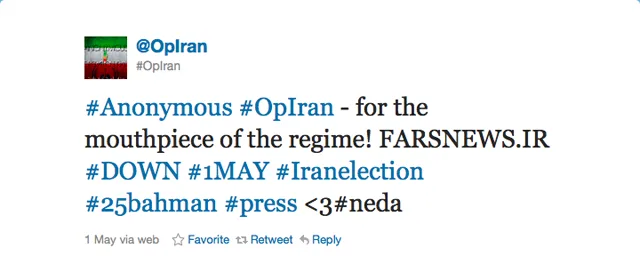
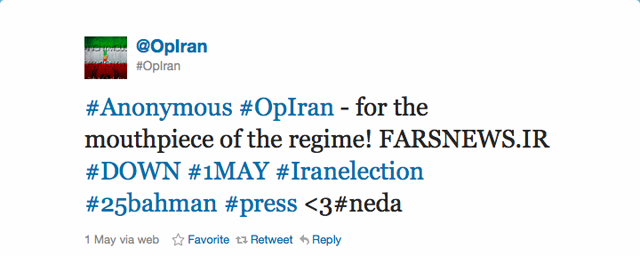
“Some of us were contacted around mid-march through social networks by Iranian students and activists,” one of the operation’s founders told OWNI. “It was them who chose May 1st and decided strategic websites to attack.” A Twitter account identifies the successes, which they are pleased to announced it hacked most of its targets. Within only four minutes after the operation started, Anonymous announced Fars News Agency’s website was inaccessible:
Soon afterwards the police website and the volunteer militia basidjs websites fell, followed by the sites of the Parliament and other governmental pages. At 2pm, the Supreme Leader’s homepage was successfully hacked.
Basijnews fell within seconds, it was shocking. On the other hand, Far News and Leader.ir were more difficult to conquer.
The attacks continued throughout Monday and lasted until Wednesday. Many websites are back online, but still are sporadically attacked. “OpIran will continue until people are safe and their needs are met,” explained an Anonymous member.
A broader target
Anonymous actions follow the rhythm of Iran’s protests. In February the movement in Iran was suddenly revived. After the opposition had been silenced for a year, large rallies were finally scheduled for February 14 (which corresponds to Bahman 25 on the Iranian calendar). For this occasion, Anonymous launched attacks which were strictly limited to government websites. Recently, Anonymous included sites that work closely with the government – including the media. In a tweet, Anonymous seems to justify hacking the Fars News Agency’s website.
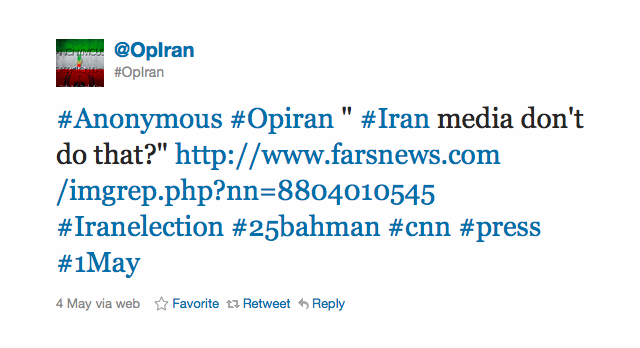
The article in the tweet was published in July 2009 during the post-election crisis, and it called for readers to denounce the people circled in red. In the eyes of Anonymous, that is beyond the media’s mandate:
Normally we do not attack the media because freedom of speech is very important to us. But they overstepped a line in broadcasting pictures of protesters. They themselves are classified as a website which attacks others.
On some of the websites that were hacked, Anonymous left messages for the Iranian Cyber Army (ICA). In December 2009, the ICA made a name for itself by hacking Twitter, arguing it was acting in retaliation against “Twitter’s interference in Iranian internal affairs.” In 2009 protestors had massively used this micro-blogging website to organize their movement. The United States intervened to ensure Iranians had access to Twitter, despite the Iranian regime’s heavy censorship.
Anonymous got its revenge. On hacked websites, they left the message “Special Fuck You” addressed to the Iranian Cyber Army and the Ashiyane Digital Security Group – a group of hackers known for having close ties to the Iranian regime. The message’s objective was intended to be a personal attack and indicates how Anonymous functions. “Some zealous people take out their own rage while leading the operations,” the representative of Anonymous said with a half-regretful tone.
—
💬 Discussion
No comments yet. Be the first to comment!