
On April 23, 2010, when the Prime Minister of Greece announced the
with the port of the island Kastellorizo as his background, three things happened. First, the Greek bubble burst. A few months before, a government whose main slogan was “there is money available” had won the election by a landslide. Second, captivated by the beauty of the port of Kastellorizo and the dazzling blue sea behind Papandreou’s sulking face, a deluge of tourists booked tickets for a holiday in Greece. Third, social networks across the country were down for hours. Not as a result of a communication cutout by the powers that be; rather, the sites were on fire. Traffic was so heavy that the servers put their hands up and the whole system nearly crashed.The boom of social networks at the beginning of the decade did not leave Greece unaffected. Thus under a more “Mediterranean” pace, social media has gradually won over the Greek youth, who in turn passed the trend on to the rest. According to research done by MRB Hellas, between 2008 and 2010 social networks’ population increased by 350%. Today, 91.7% of online citizens have an account on at least one social network, with youth as the majority (72% Facebook, 36% YouTube, 20% Twitter). Approximately 25% of account holders spend about 1-2 hours per day online and 23% spend about 2-4 hours online each day.
According to all the familiar clichés Greeks are hyper-social and love glamour, self-promotion, having fun and politicizing everything. Though just a cliché, the research does beget the question: what are Greeks doing with all those hours?
They socialize of course – they spend 57% of their time on social networks staying in touch with friends and acquaintances (some of which they do not see often). They exchange comments and they post photos, preferably in cheerful and artistic poses.
They upload videos and songs – and sometimes they remix them to make it humorous. The most well-known example of this is the extremely successful video “
” (The wine of Tsu), where a Japanese song is “transcribed” in Greek, with words of similar sonority and the result is hilarious. Another favorite topic is Bruno Ganz as Hitler in “Downfall.” The dictator is always ranting about something, but the subtitles vary: sometimes it’s the , a Greek porn star releasing a new video, or a disappointing football match.Downloading is popular too. There aren’t official statistics concerning illegal downloading videos and songs – but when a court ordered the most popular Greek torrent seed side, “gamato.gr,” to close down, the protest group on Facebook gathered over 5,000 members within days.
When they are not illegally downloading, Greeks flirt online. The era of searching the beaches for prey (innocent girls and young blonde tourists) is over. Long live Internet flirting! According to Badoo.com, Greece (particularly Athens), is the leader in Internet flirting: 33% of users admit they had some sort of sexual relation after intense online flirting. A year ago, the first online marriage proposal through Facebook, gathered 10,000 “likes” in a few days and helped spur a young man to actually make the proposal a reality. The cartoon movie of Alexandros’ and Aurelie’s love story became one of the most popular videos on Facebook in Greece.
The second most important activity of Greeks in social networks, at 30%, is to learn about and comment on political issues and current affairs. Cliché alert: the country that invented democracy is also politically active online.
As far as authority figures are concerned, politicians have begun to overcome their fear of social networking. The Prime Minister himself, self-proclaimed fan of social networks, has been using them for a while. On November 5, 2010 he gave his first online interview on Facebook and Twitter (with the hashtag #GreekPmLive). Other members of the Greek political scene don’t seem to be as web-savvy as their Prime Minister: only about 20% have a Twitter account and little more have a Facebook account.
As far as the governed are concerned, things are different. Looking back, June 1st, 2007 marks the first instance of political activism. Almost all bloggers throughout the country published the same post in protest, following the death of blogger Amalia Kalyvinou. Amalia had been for many years suffering from an undiagnosed cancer and she had been denouncing corrupt practices in big hospitals in the country on her blog, criticising the lack of social responsibility. The subject quickly moved from the blogosphere to the traditional media and was even brought up in Parliament.

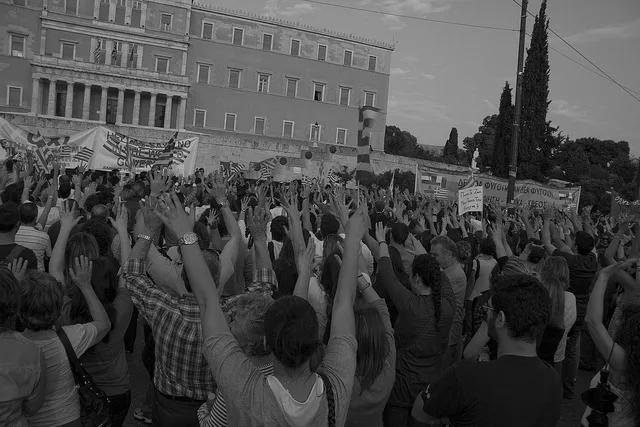
The Greek indignados (Αγανακτισμένοι) in demonstartion called over by social media on May 29th 2011 at syntagma and propylaia university
The first genuine boom in social media activism for political purposes took place in December 2008. During the worst riots Athens had ever seen, a police officer killed a 16-year-old student. He was later sentenced to life imprisonment. It was as if all political forces, regardless of their alignment, had suddenly understood the power of the Internet. The demonstrations were organized on Facebook, they were live tweeted and they were shared with the world on YouTube. Endless articles, videos, comments and pictures flooded the networks.
And then Greece was summoned by the IMF. The information landscape began to change. Many Greek citizens, now anchored in social networks, voiced their discontent with traditional media, which they saw as “motivated by interests linked to the current economic situation.” Evidence of the use of the Internet as a source of information is that 74% of social network users say that they often go online to comment and dig out more information on news they have seen on TV. Of course information via the net is not only sought out through social networks, but also on the websites of traditional media. Television news continues to hold the primacy, but online information is catching up, with only eight percentage-points of difference. Consequently, popular bloggers like “Pitsirikos” have become powerful opinion leaders. Around 53% of social networks users have already commented, one way or another, on the “Memorandum” of the IMF.
Social networks, however, don’t just provide a platform for commentary on the crisis, but also to help coordinate action. The most impressive example is the documentary “Debtocracy” by journalists Aris Chatzistefanou and Katerina Kitidi, which was entirely crowd funded, following the creators’ online request for support for an independent production investigating the causes of the crisis and possible solutions. The request was widely circulated in the networks, and in ten days, the budget for its production was collected. After the documentary was posted online, it attracted over 500,000 views in just two days. Later on, it was purchased by a major newspaper that offered it on DVD with its weekend edition. As a result, social networks were rife with petitions campaigning for the formation of an independent committee, responsible for assessing the exact amount of the debt and the practices which allowed it to grow to such an extent. Finally, citizens are keen to find out whether Greece’s debt can be classified as ‘odious debt’.
In the past two weeks more than 100,000 people have gathered each evening in the central square of Athens (a city with a population of approximately 4 million), inspired by the kindred “indignation” movement in Spain, to protest against the country’s current plight. The same rendezvous have occurred among citizens of Thessaloniki, Patras, and other large cities. Central squares were deluged with protesters of all ages and political views, despite the rally being organised in just a day’s time on social networks.
An open assembly identifies, moderates and directs people’s demands and is broadcast live every night on the Internet. Criticisms and analyses widely circulate on the net (hashtags #greekrevolution #25m #syntagma). Some are humorous, like the Facebook group “Give the 300 a moutza with one click,” where 300 refers to the number Greek MPs while a “mountza” is an insulting hand gesture. So far, this is the most popular, peaceful demonstration organized entirely through the social web, and devoid of participation from legitimate political formations and parties.
Business-wise, it appears that investment on the networks are as stagnant as general investments in Greece. Companies are mostly wary of the Internet and do not seem willing to trust it: only a third of them have some presence in social networks. The market is still small – only 12 million Greeks – but has potential and is expected to grow within the near future.
 The first “online game show”, MATHE CLICK (lean to “click”) was launched on Facebook by a company called OPAP. It’s hosted by the famous Greek comedian George Mitsikostas. To participate, one must apply on OPAP’s Facebook page and wait until 10 players are selected at random. On a specific day and time, they sit in front of their screens and answer questions live, as done in a game show, but from home. Other Facebook users can watch it live, but cannot participate. This initiative was a huge success, with over 45,000 requests for each game and more than 10,305,000 post views. It continues today, and the presenter’s catchy quips have now become an online meme.
The National Bank of Greece, taking advantage of the fact that computer illiteracy is higher in seniors, has launched the impressive website deixtous.gr. On the site, users post videos or short stories based on a funny experience between
. The best post wins a prize. At the same time, the site establishes a national network of volunteers whose role is to introduce the elderly to the magical world of the Internet. The website and its applications have had a resounding success; within the first 15 days, it attracted about 150,000 visits and over 250 participants in the volunteer network.Technology, crisis and sociability have been the three essential ingredients for the development of social networks in Greece. Delayed in the level of business activity, pioneering in political militancy, passionate about personal promotion and social life, Greece seems to be dynamically invading the field of social media. But if, as they say in my village, “predictions for the future of the economy make astrology sound credible”, predictions about the future of social networks certainly seem to upgrade astrology to an academic science.
This article was originally published by The Social Media Club
Photo Credits: Flicrk CC RobW_, odysseasgr
💬 Discussion
No comments yet. Be the first to comment!