
* This investigation was conducted on IRC (Internet Relay Chat), a communication platform permitting exchanges with hundreds of people simultaneously.
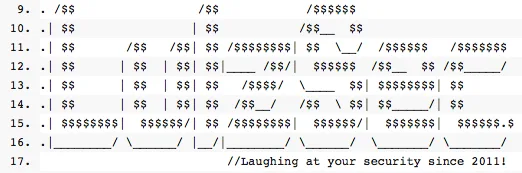
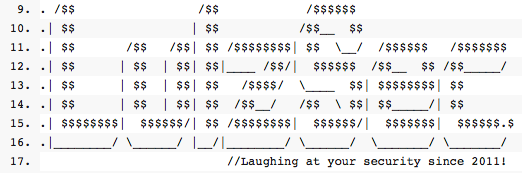
A LOL boat created in ASCII Art (a form of code) appears, followed by jazz music and a list of Lulz Security’s victims. Also known as LulzSec, the mysterious group of hackers’ intentions are clear:
Targets: whitehats, spies and federal agents. Erase them from our community. Sailing the boat Lulz, beyond the seven proxies.
Active since May 2011, these repeat offenders have successively attacked candidates from the X Factor TV show, Fox News employees, the America network PBS, the Canadian Conservative Party, Sony, Nintendo, and a security specialist collaborating with the FBI. Out of the 17 acts of piracy recorded against Sony since the breach of PlayStation’s Network[FR], LulzSec claimed responsibility for six of them. The group quickly became a hybrid between the French television show Action Discrète [FR] and WikiLeaks.
In a media and political climate marked by a fascination with hackers and their actions, everyone is curious as to what exactly is LulzSec and its objectives. The response might be in the question: The lulz is an image-board subculture (like 4chan) which consists of laughing sadistically at others’ misfortune from a distance. In July 2010, an American teenager named Jessi “Slaughter” had a bitter experience. After posting a video on YouTube, the 4chan legion unleashed its wrath on her. While the court was considering the case, the girl’s father issued a warning which was soon twisted and hijacked by the anonymous group:
Consequences will never be the same.
Almost a year later they have the same motivations, mainly there is no higher objective other than the fact they can be mobile – which is the common denominator in attacks launched by LulzSec. After the politicized attacks from Anonymous during the Arab Spring and WikiLeaks’ incident, are we now witnessing a historic but nonsensical digital surge? Even the group’s logo (Which looks like a combination between Trollface and Rage Guy) seems to support this theory.

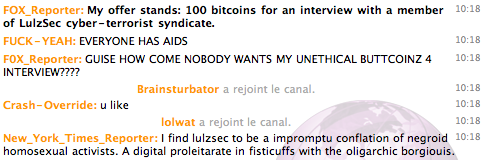
“100 bitcoins for an interview with a member of Lulz-Sec”
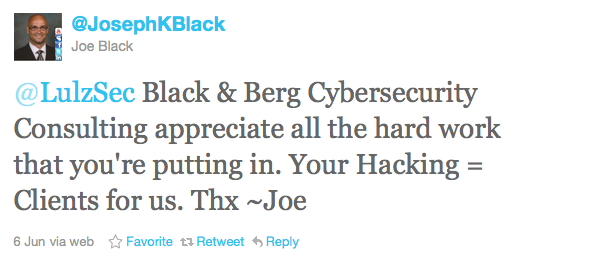
Chased by the FBI (which has made no arrests despite the rumors), LulzSec continues to taunt authorities by planting false evidence over the network. Some believe LulzSec revealed themselves, but the group’s zealous activities prove otherwise. A cybersecurity expert ironically tweeted on the financial opportunity afforded to him by this wave of piracy:
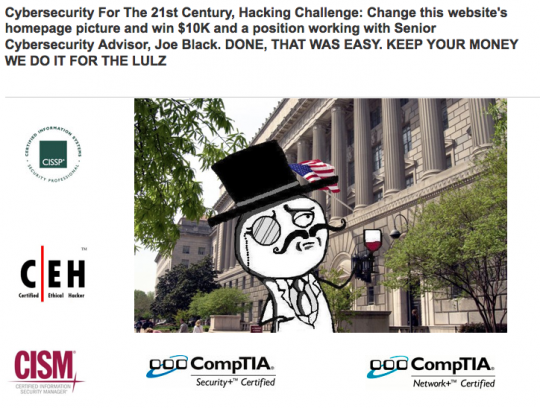
His site was defaced in return:
In newsrooms world-wide, journalists are seeking information regarding who is behind this congregation of obstinate pirates – but obviously there are limits to this exercise. In an article by the BCC concerning Lulz security, they conceded in saying “No-one knows.” Taking advantage of the opportunity, the hackers tease the press as it appears they hold them in the same regard as governments.
If you look at the IRC channel, there are messages from Fox reporters (probably fake), who offers “100 bitcoins (a cryptocurrency) for an interview with a member of Lulz-Sec cyber-terrorist syndicate.” A few minutes later there was a similar request from a BBC journalist (also fake?). He left the chat a few minutes later.

To better understand Lulz Security’s origin, it’s helpful to refer to Encyclopedia Dramatica, the Wikipedia for Internet culture that records all its manifestation (with the strangest being the most viral). Not surprisingly, there is no trace of a Machiavellian plan to reverse multinational trade. Overall, LulzSec take everything as a hysterical joke, even if certain people are getting annoyed with the group’s systematic actions:

But isn’t that the trolling culture?[FR]
Contacted by OWNI, Lulz Security would not give us an interview. LOL.
Photo Credits: Flickr CC openfly
💬 Discussion
No comments yet. Be the first to comment!