
Sometimes you come across a project that, in its simplicity, manages to hit not one, but several important knots in the contemporary cultural landscape. It doesn’t necessarily need to be a game-changer, but it definitely makes a statement through its self-evident utility. When I came across Golan Levin’s Infoviz Graffiti Pie-Chart kit, I immediately thought it was the case.
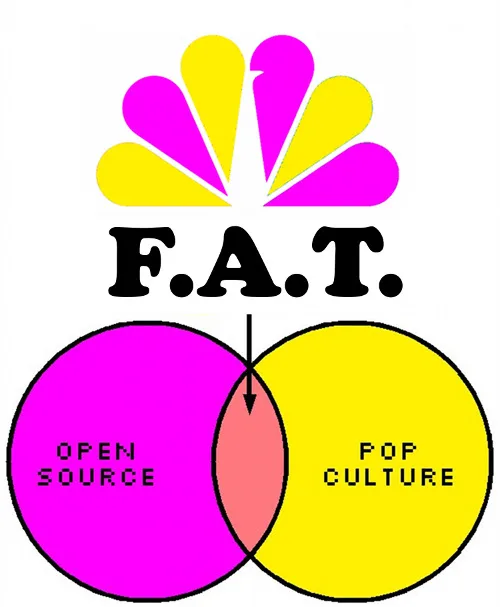
Levin is a new media artist, a teacher, and also a member of F.A.T., an artist collective whose extended name is Free Art and Technology Lab. You might know him for his piece Dialtones: A Telesymphony (2001) – in which he managed to perform a concert through synchronized calls and ringtones on the audience’s phones – or for his many other exhibitions in prestigious events like the Whitney Biennial and Ars Electronica.

What struck me about the kit was its extreme rawness and lo-tech approach, contrary to Levin’s usually far more sophisticated inventions, but also its timely and to-the-point realization.
These days it’s hard to surf any website without bumping into at times confusing infographics, often beautiful but unreadable, and pictures of arguably political street art are just as common. What links the two is the eagerness of both infoviz designers and street artists to get a message out there, to take advantage of an easily accessible medium in order to channel certain ideas.

In times of political tension (and we know these are), before being typed by hordes of Twitter-using revolution sympathizers, the most pressing social demands still appear on walls. Or, in case the tweets come first, it is not until somebody gets them on the walls that the authorities start to get worried. I am aware that infographics and social media are not the same thing, but the latter are indeed a big tool for diffusing the former, and both – at least in my opinion – are part of the same short-attention-span world.
Infoviz graffiti is thus a provocative exhortation to get the substance of immediate information and infuse it with the boldness of political rage, hopefully defacing public properties and informing people at once. There is definitely some paradoxical irony in that, but I found the pie-chart format – possibly the simplest and most old school type of infographic around – just perfect for the task. It basically says: do it yourself, keep it simple, and get it out there.
To make it sure I got the point right and in order to put it into context, I decided to contact Levin himself and ask him a few questions about what stands behind his project.
Our information-environment interpenetrates the fabric of urban space. (Kevin Slavin has even convincingly argued that urban space now conforms itself to the needs of information flows.) But this relationship is not owed to some new feature of augmented-reality iPhone apps. It has always been this way; before the Internet, we had the agora, the pashkevi, the broadside. Information and urban space have always been coextensive, and impinge on each other; this is why e.g. the locus of the “Twitter revolution”, if there really is such a thing, is the Arab public square and not the PC in the family office. My stencil project simply corrects a technological bias in the ways we typically receive and consume visual displays of this information: a correction to the overprivileging of the digital screen and printed paper as the expected vehicles of information transmission and exchange. The pie-chart stencil addresses a paucity of tools for the high-speed reproduction of infographic messages in and around urban surfaces.
Earlier this week, someone generously tweeted that my project was “Banksy meets Tufte“. Although that’s high praise – both of these men are personal heroes – this remark definitely delineates the territory I’m seeking to explore. Certainly, it’s clear that Banksy and Tufte both share an aesthetic of graphic efficiency and a faith in the communicative power of simple messages. And of course, both street art and infographics depend on extreme visual economy to communicate effectively and memorably: graffiti must be quick to execute, charts must be easy to read. The key, I believe, is that both must also provoke. What makes my project significant, I hope, is that it reminds people that even a simple pie-chart can be used to communicate information that matters. It prompts us to question what information is worth visualizing, and why. Furthermore, by situating quantitative visual information in urban space, this project also compels us to commit to a confrontation with a specific audience in a specific locale.

It seems clear that the field of information visualization possesses tools and media which, suitably adapted, can bring new communicative capacities to street art. If street art has lessons for infographics, on the other hand, it is to remind us of the pressing need to explain the egregious problems of the world today, to the widest possible audience, and to prompt tactical thinking about how (and where) this be done most effectively. What data is essential to communicate to others? Can the insertion of that data, semi-permanently, into urban space, change people’s behavior? When is it worth risking arrest to ‘publish’ that information? These are the questions I hope my stencil project raises.
As an artist, I try to leave the world a more interesting place. I’m also an educator, so I care that people learn something new, and become empowered in some way.
—-
Many thanks to Golan Levin for his participation! If you want to read this interview, enriched with replies to some other complementary questions from FastCompany.com’s Suzanne LaBarre, you can also go check out this post here.
💬 Discussion
No comments yet. Be the first to comment!