
In an interview with Ted Rall (an award-winning American political cartoonist), he explains how he uses the Internet, blogs, and Twitter, and how he recently used crowdfunding to pay for a business trip to Afghanistan.
Well, that started in the 90s. I had a friend who was a tech guru named Simpsons Garfinkel – he wrote books about the Internet. Back then he said “You better get a website, everybody is going to be doing it in the future.” So I followed his advice and built a website. I started by doing all the programming, then I used Blogger, and now I use Wordpress. I think it’s basically impossible to make a lot of money from a cartoon website, but it acts as an advertisement and a directory – if people want to find you, they can. I don’t find it particularly exciting, but if an art director likes your work and wants to hire you, probably the only way for this to occur is through the Internet.
I guess the only trend I followed in the early 90s was inspired by Scott Adams, who draws the cartoon Dilbert. He started putting his email address on his cartoons, to interact with his readers. I copied that, and so did several other cartoonists that I knew. Now we don’t published our email accounts, instead we put our websites because people can email you through the website. I can’t say that I was the first to have a website, but I was definitely one of the earlier ones. I had my website up for a long time, since 1994 I think.
It was through a friend of mine, Stephanie McMillan, who is another cartoonist. She used Kickstarter to fund a children’s book that she co-wrote with Dereck Jensen. I was expressing my frustration with the fact that I wanted to go back to Afghanistan, but I could not find anybody to fund the trip because all the print outlets would not provide the kind of funding for foreign correspondents like they did 10 years ago. She said “Well, why don’t you try crowdfunding?” I put together a little video and a page on Kickstarter, explaining I needed $25,000 – which really isn’t that much when you consider how expensive foreign correspondents cost in war zones. I received $26,000 from people who really wanted me to go to Afghanistan and cover the story. It worked out very very well. I can’t say that it is something that you could probably do all the time, but it certainly worked in this instance.
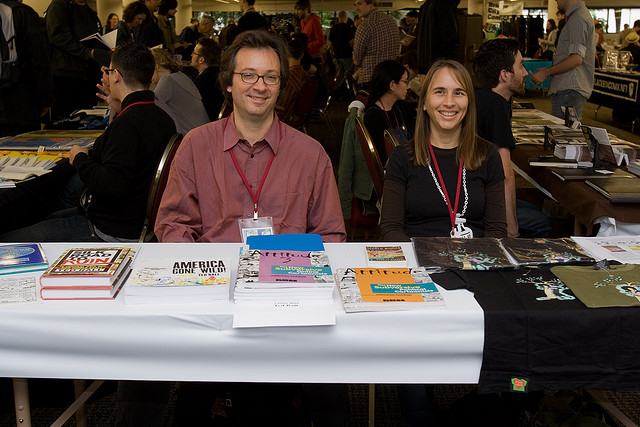
Ted Rall (left) and Stephanie McMillan at Stumptown Comics Festival in 2007 (Photo source: Flickr Ocean Yamaha CC)
I know the person’s name, but it wasn’t a friend of mine or anything like that….
I know, it’s kind of amazing. I joke that maybe it’s people who hated me and wanted to see me go to Afghanistan.
I use both Facebook and Twitter, although I have to say that I don’t find it useful. I’m very focused on the amount of money I can earn from using a tool, and I don’t think Twitter and Facebook have ever put a penny into my pocket. You know, it’s fun and people like to hear from you. Like you say in French it makes you engagé, but I don’t think it significantly promotes your career. Your fans will be like “Oh look, cool, he is on Facebook,” but that’s about as far as it goes.
I honestly think the economics are more important than format. Sure, there are no limitations to the space you have online. But space is not the main issue when it comes to covering war zones. You have to travel, and it costs a lot of money. Except for business models like Kickstarter, I don’t know how long publishing on the Internet is going to last as a viable solution. I don’t know how an unknown correspondent could finance a trip to South Asia. I mean, I was able to get the funds because I’ve been there before, so people knew I could deliver. I think, for the most part, the Internet has been a very negative development for cartoonists. It’s very good when you are 21 years-old and are having a hard time getting your work in front of people because editors are refusing to put you in the newspapers – then the Internet is great. When I was 21, I would have loved it. But when you are older and trying to make a living, it doesn’t do you any good at all.
Yeah, certainly people found me online so it’s useful, without a doubt. It’s essential – you have to have a website these days, regardless of what kind of business you are in.
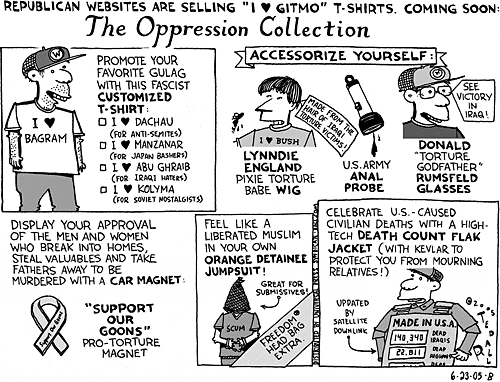
A cartoon by Ted Rall (Photo Source: Flickr AJ Franklin CC)
I’ve done that as well, but I haven’t had much success in selling this product and I don’t think anyone else has had a lot of success either. Mark is unique, and I guess Diane Thomas from the Washington Post is successful too. I hate to be so negative, but I don’t know if it has been a very successful endeavor. People are waiting for the next new thing to come along and it hasn’t arrived yet – we don’t know what it’s going to be. From an optimistic standpoint, I think that it’s a matter of time before there is a new economic model which will disseminate cartoons in a fashion that will put money in people’s pockets. Cartoons have been around for thousands of years and it’s a very popular medium, people love them. Right now, the cartoon industry is going through a terrible transition, and once we figure out our model the situation will be much better. But we don’t know how to do that now.
There is significant potential in mobile phone, particularly for political cartoons. I can really see how people would like to read about a current event on their phones with cartoons, and then share it with their friends. If there is micro-financing, a way to charge a few penny per person who consumes the content, it will be great, definitely. But we are not there yet.
____
This article was originally published on Thomas Seymat’s blog.
Photo Credits: FlickR CC roniweb, Ocean Yamaha, AJ Franklin
💬 Discussion
No comments yet. Be the first to comment!