
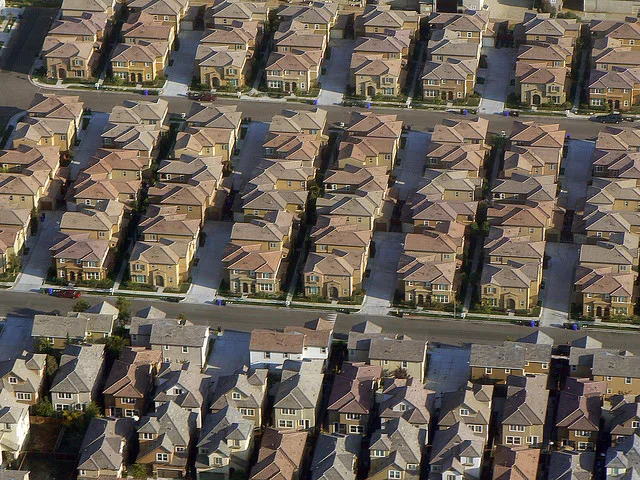
Full of promises of innovative transport and mind-blowing infrastructure, Greater Paris relies on a dangerous economic fiction: a development financed by infinite urban expansion.
Do you get a kick out of Madoff? Then you’re going to love these different varieties of the Ponzi Scheme. The Club of Rome wrote extensively on the topic when addressing sustainable development. Strong Town (an organization that advocates for more densely populated American cities and towns) spells out the growth Ponzi scheme here, here, and here. These publications make their arguments in economic terms and deconstructs the mechanisms behind urban sprawl.
The “cornucopia” of urban sprawl
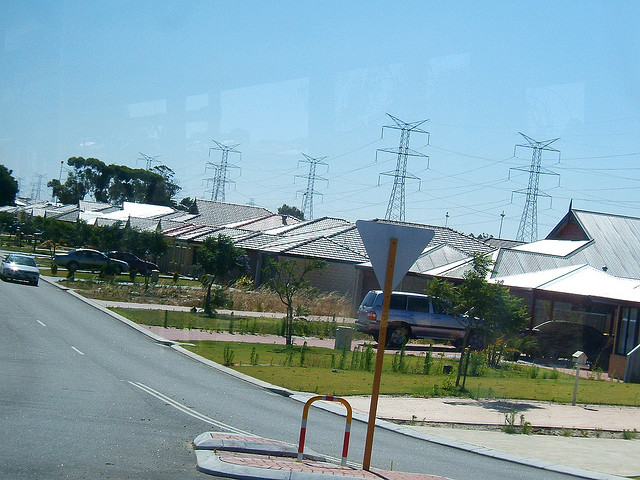
The American way of life, which fundamentally relies on urban sprawl, throws caution to the wind and finances itself by betting on perpetual growth. Failure was inevitable since the beginning, especially because American infrastructure networks are almost entirely financed by the federal government, yet local governments are responsible for maintenance. Two market failures support this hypothesis: the sub-prime mortgage catastrophe (born in the extremities of urban sprawl) and the oftentimes complete abandonment of infrastructure maintenance. Other examples of the Ponzi scheme exist, such as shale gas operations in the United States, the “full speed ahead” mentality concerning development in Greater Paris, and investments in fiber optic cables’ installation.
I don’t want to analyze the current situation – I want to explore how to escape the vicious cycle.
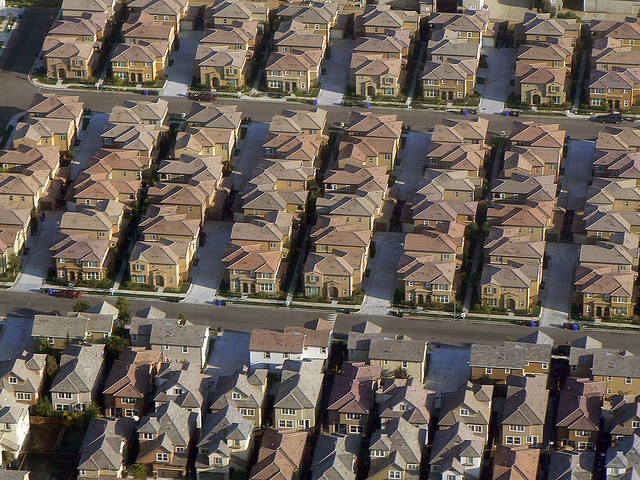
The prosperity principle – build a city outside of a city – laid the groundwork for American peri-urban development. Yet this principle never tested its own limits so long as growth continued. The first critiques surged when the residential and commercial real estate markets collapsed. These suspicions were then reinforced by local governments’ difficulties in paying maintenance costs.
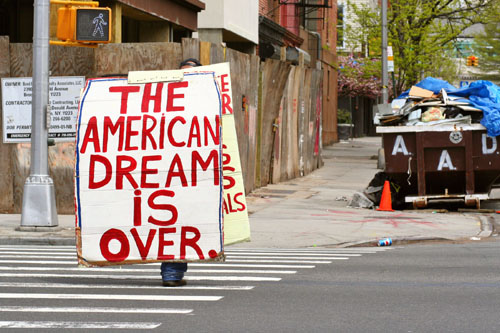
The inflationary development of infrastructures necessary to perpetuate urban sprawl started to reverse, showing signs of a shrinking economy. This model for development is intimately connected to the “American dream” idealism, and no one is about to call such a powerful image and concept into question. A small group of analysts are sounding the alarm, while the majority continue to believe in the growth of cities at the first signs of economic recovery. How long can this last? Madoff must have asked himself the same question. The difference? Sure, he was betting on infinitely increasing investments, but he knew that he’d have to face the music someday. We still refuse to pull our heads out of the sand.
The initial investments – the vast majority funded by the federal government or by loans with preferential interest rates – are relatively low for local governments. The bear trap of this bargain snaps when local governments must repay their financial commitments at the same time that the infrastructures wear-down, demanding high maintenance costs and eventual replacement. The shortsighted nature of local governments’ actions are justified in the following ways:
- The city will finance maintenance with the extra revenue produced by urban growth.
- The city is constantly accelerating its growth so as to generate enough revenue to finance the maintenance of the existing city.
Ponzi would be proud. As we all know, cities don’t grow indefinitely. The second assertion, then, certainly doesn’t hold water if the first premise is systemically disproved through experience. This is why urban sprawl doesn’t work: the continually multiplying costs outweigh their utility, which becomes increasingly marginal as population density decreases. The irrational growth of debts leads them, slowly but surely, to a painful end. Cities whose infrastructure maintenance and replacement expenses are carefully monitored escape this mise-en-abyme.
Asphalt: Any time, Anywhere’s nightmare
Let’s look at two examples.
- A town finances 50% of a country road. It takes about 37 years for the town to recuperate the costs of the road’s construction while the lifespan of a road is about 20 to 25 years.
- The (necessary and unavoidable) cost of replacing a city’s water treatment facilities costs about $27,000 per inhabitant, which is about equal to the average inhabitant’s net income. Without outside financing, such a replacement would be impossible.
In each of the studied cases, the costs of the investments paid by the city through federal public funds, debt or private-public partnership outlasts, by decades, the life of the constructed infrastructure. Each time a road or water processing plant must be replaced, the process of investment has to start all over again – to the disadvantage of the local government. And local governments keep increasing their debts to develop – not only replace – infrastructures to avoid traffic jams and unhappy voters. When growth stagnates, debt doesn’t just take off – it soars.
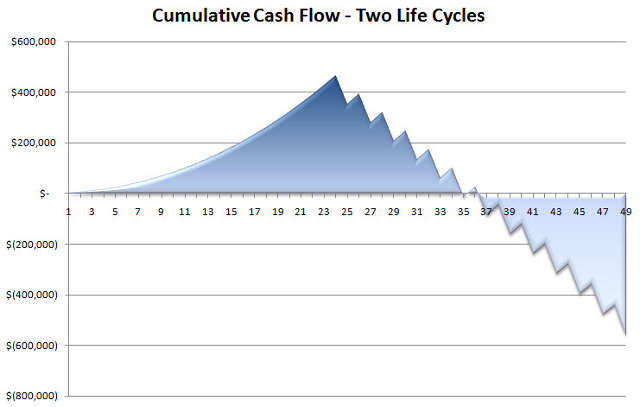
The curve represents the available capital of a given city or local government. The first part of the graph shows the available capital once the new infrastructures begins to generate new revenue growth for the city. The decline begins when the infrastructures need replacement, which costs about the same as their initial construction but does not generate any new revenue for the city.
The system therefore consumes revenue instead of creating it. The modest short-term benefits are overtaken by the massive long-term costs. A sustainable life cycle of infrastructure is possible in a city whose additional revenue resulting from growth is enough to pay for its maintenance and replacement. If two major structures need replacing at the same time, the model implodes. Revenue growth can handle the costs of maintenance, but the astronomical cost of replacement rapidly dries up resources, making the system collapse.
Greater Paris: The biggest rip-off since Madoff?
Is shale gas just another Ponzi scheme? The New York Times thinks so. It’s observations are echoed on this side of the Atlantic as well. Under ideas of progress and public interest, France viewed fracking as a serious matter – until recently. Isn’t their lack of making further investments a sign? Does the state no longer have the economic means to deal with the issue? Is the government renouncing public service?
On one hand, more and more cities and towns are showing signs of failure. On the other hand, the federal government is maintaining the facade of having the means to make considerable investments – but it’s just empty talk. The federal government has gone so far as to pledge billions of dollars for public transportation projects.The national public transport scheme announced by the French government in 2010 shows 170 billion euros worth of investments, but unfortunately concludes with pleas for millions of euros of outside investment. It’s the same story twice over for installation of fiber optic cables which could only potentially pay for themselves in densely populated areas. The public transportation infrastructure of Greater Paris spawns the same analysis (and critiques) as those of Strong Town.
The urban planner Frédéric Leonhardt (The wonderful tales of Greater Paris) is extremely critical of the financial integrity of the project. In his words, “All the ingredients for a public, industrial crash are united.” He proclaims the Greater Paris Express a “the Grand Canyon of deficit.” Add in the budget-consuming costs of underground network expansion (auditors asserted that costs could increase up to 92% on this type of project), and Leonhardt seems to echo exactly the argument of Strong Town….
Only one true study has been carried out to estimate the real cost of new underground networks (Député Carrez’s report of September 2009). Besides an initial investment of 24 billion euros, it would be another 19 billion euros to ensure proper functioning of the new networks from 2010 to 2025. This needs to be added to the already existing transport deficit, estimated at 24 billion euros.
… And that’s not taking into account other eventual costs.
The actual work load for the STIF (with a budget of nearly 8 billion euros per year) will be substantially increased by supplemental networks. The additional zones, which are drastically less populated, generate less traffic and fares will be less advantageous for travelers than those currently charged on the RER and metro networks. Combined with increased initial costs, this fact will render the financing and realization of this network in its entirety largely impossible.
… And that’s not taking into account potential consequences.
Beyond the financial aspects, the disadvantages of the “new and beautiful” strategy are accumulating. Delays in implementation, 10 years on average, are much longer than would be possible by recycling current assets or using viaducts. In addition, a subterranean infrastructure produces more carbon emissions; one kilometer of tunnel produces 40,000 tons of CO2, or a minimum discharge of 6 millions tons of CO2 for the construction of the network. These are known arguments. However, they didn’t frighten those who made the decision.
The decision made was a point of no return, except if a majority shift occurs at the 2012 presidential election and the newly elected successors have a little more financial sense. Frédéric Leonhardt reminds us that other issues exist that are woven into the same thread of illusion.
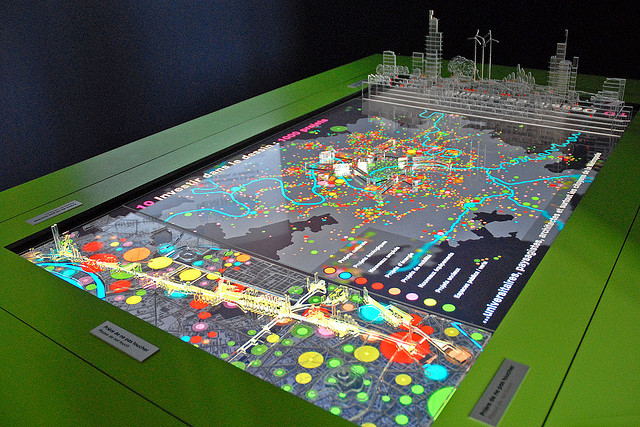
Why this collision course? It vehemently reminds us of national cases, such Lignes Grandes Vitesse Normadie and Sud Ouest for example, which show us the astronomical cost of construction while still making local government elects’ mouths water. They see the state arrive with fantastic projects, guaranteed hassle-free, promising them a dynamic economy (and happy voters).
It’s a heavy but understandable responsibility. The situation is based on American analyses: the bargain effect, peri-urban expansion logic, non-pertinent investments, decreasing value, ridiculous operating costs, unpredictable spin-off costs…and colossal debt. Faced with these economic inconsistencies, the effects on the daily lives of citizens remain to be seen. If the government endorses these actions, then what’s stopping the average citizen from adopting them too?
The alleged outcome of these blind bets on the future has a lot to do with the recent economic crises and the weight of social expenditures. It has a lot to do with environmental and social challenges that all come at the same time. However, other bets exist on the future which may allow us to escape the city (check out the“peak-car”[FR]).
Article originally published on Groupe Chronos under the title De Madoff au Grand Paris. [FR]
Photo Credits: Loguy for OWNI; FlickR
 futureatlas.com ;
  ricksomething ;
  afterthetone ;
  Kat ; dalbera.
💬 Discussion
No comments yet. Be the first to comment!