
![[PHOTO GALLERY] Chaos Communication Camp 2011: Hackers rejoice!](https://owni.eu/uploads/owni/ccc-une-df4f9b77.webp)
In August 1999, the first Chaos Communication Camp was organized by the Chaos Computer Club, infamous Berlin hackerspace. The camp was organized around the theme of security – or rather, “insecurity” to borrow Wired’s words[PDF].
Ten years later, the security is one theme among many. Now, our entire society that hacks itself, as though responding to a moral, economic, and political crisis that chips away at the status quo. It’s a development that epitomizes the change in scope of hackers, past the sealed basements of the Plaza del Sol in Madrid. Or maybe it’s just the times have proven themselves favorable to this group. Is hacking the new avant-garde?

1999: “Nerds, hackers, and phreaks from around the world.”
“Hacker Woodstock” began ten years ago in Altlandsberg, next to a lake. It was loosely based on Hacking in Progress [NL] or HIP, a similar festival that took place two summers before next to Amsterdam.
“Nerds, hackers, and phreaks from around the world.” About 1,500 hackers attended to reflect for three days on technical questions: security vulnerabilities, cryptography, and reengineering. The nerve center of the event was a giant tent, which was surrounded by computers connected to a wireless network. Everyone settled in a themed village according to their personal taste. One of them is still dedicated to “art and beauty” or more plainly stated, for the creative use of technology.
Legend has it that in this small world the mission was to repair a ship, Heart-in-OR1, including the outdated and dysfunctional motherboard. The machine sat in the middle of the field, glowing like C3PO. The story will be repeated in subsequent editions.
Even if the collective brain activity was intense, the atmosphere in the camp was more like being on vacation than engineering school. In the leisure lounge, DJs played music, beer was as plentiful as the wi-fi debit, and there were just as many space cakes as waffles. Violence was banned (that’s how a young participant who tried to attack the network got the punishment of cleaning toilets).
This nerdy aspect should not overshadow an inherent characteristic of German hackers responsible for the event, as summarized by Wired [PDF]: ”The movement hacker in Germany is so well-established on the front-lines that it has virtually established itself as a branch of government.” When asked by Computer World [pdf], the CCC spokesman Andy Muller-Maguhn noted “that unlike the U.S., which imposes export restrictions on encryption, German politicians have listened to the hacker community’s advice and have therefore chosen not to impose similar controls.”
People have always been critical of Fascism, that’s why they want to control technology and not be controlled by it.
Technical though it may be, cryptography is mainly a way to defend freedom of information. Computer World [PDF] reported Dave Boyce’s explanations, who worked for an ISP in Amsterdam. He said “the ultimate goal of the camp was to create a network of technical and human activists to defend such policies.”
It is essential that the crypto stays free of government control so that we can continue to exchange information freely because ultimately, our freedom begins with the exchange of information. What we do is create a framework for freedom of information.
This specialization on security issues makes hackers a choice target for businesses and governments. David DelTorto, chief technology officer for security services at Deloitte & Touche in San Francisco, organizes workshops entitled “Take this job and ping it” or “hacker levels of the company for fun and profit.”Journalists are told to watch their steps, along with “business visitors,” meaning anyone ”rich or working for a company or government that wants you to be present at the camp because there is much to learn, or because you have a commercial interest.” The wealthy must pay an entrance fee of 1,500 marks, or about 770 euros.
Yet some are complaining about that this monomania, such as Stephanie, a young Dutch woman [PDF]: “It’s nice to camp, but at HIP, there were more interesting people and a larger variety.”
2003: “It’s a state of mind”
The following edition took place over four days, and seems to have found its niche. The titles of the conferences were obscure and somewhat profane (“why PKI and digitalsignatures suck,” “SELinux - the NSAs secure Linux,” “Congestion control inIP networks”), and politics hung over the camp, just like the makeshift miniature aircrafts made by participants. Just read the introduction to the conference program:
The camp aims to promote the exchange of ideas and technical, social, and political concepts so as to find new means to make the world a friendlier and smarter place.
In the video presentation, one of the organizers explains the CCC is “not a mainstream commercial event – it is for hackers, and there is a broad range of hackers. It’s not just the stereotypical guy behind his computer, it’s more of a general approach on how to see life and understand things. [...] It is a state of mind.”
John Gilmore, the founder of the EFF and hacker historical figure of the cypherpunk movement, describes his point of view: “The case of John Gilmore vs Ashcroft started because I did not like the U.S. policy requiring people to show their identity card before taking a plane. I thought it was unconstitutional. It is not good for a free and open society. It’s good for a police state.” On a journey from San Francisco to London, he wore a badge “ Suspected terrorist.” The captain asked him to remove it, he refused, arguing that it’s “a political statement.” The request turned into orders because “it endangered the safety of the aircraft and violated federal law.”
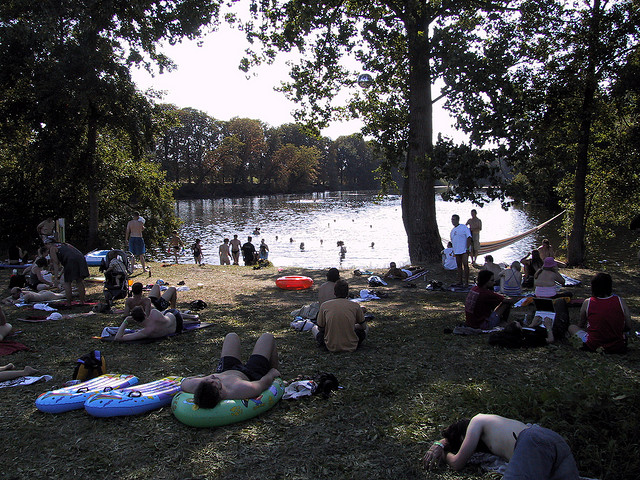
Between two socio-technico-political discussions, the campers who invaded the 60,000 meters-squared area of the camp have some fun. As one organizer explains, attendees are kids at heart and take part in activities such as LEGO, over-sized blowup games, friendly rumbles, swimming….
2007: “hackers, artists and associated life-forms”
Five days of festivities adjacent to the Museum of Flight [de], “hackers, artists and associated life-forms” were housed in a former Soviet base. The meaning of “associated life-forms” being the makers, fablab, and other DIY enthusiasts, and just as many people who affect the revolution themselves.

Reflecting the times, the press release presents the program containing 76 different lectures in political terms:
“The increasing surveillance of the individual, nanotechnology, attacks on GSM network, and other topics related to security, there is always something exciting going on.” The animations fall under six categories: general, hacking, society, science,community and culture.
One workshop was even entitled “Global Democracy.” Expect no less when the purpose of the conference was to have discussions about “technical and creative ideas for the world of today and tomorrow.”Speaking of tomorrow, a day nursery welcomes baby hackers.
The speech to the press was better articulated: “The press is welcome – openness was and is one of the key values of the CCC. However, we ask that you to pay attention to certain rules and respect the privacy of our guests.” This was much nicer than a direct attack to respect privacy, like in 2003 [en].
2011: “A modest proposition for the next 23 years”
The 2011 version is here, and amplifies the scope of the previous editions. It again invites “hackers and associated forms” to the “free exchange of technical, social and political ideas”(take a look at the long list of programmed activities).
All the buzz creates enthusiasm in the small French community gathered at the FrenchEmbassy. Mark from Tetalab encourages dialog within this community, and he welcomes an approach that sparks people’s interest and is open to citizens. To follow Mark’s example, several members were interviewed about their favorite points of the conference:
Alex (Tetalab): “The r0cket badge (the badge of the CCC in 2011, this manufacturing method, ed), conference on DYNDY Bitcoin and new monetary systems. I find it hard to explain it to people, yet they manage to organize all these great ideas on the Internet grassroot with Rop Gonggrijp, the founder of XS4ALL4 3. There is another one entitled ‘Journalism needs hackers to survive.’” OWNI’s not about to contradict that….
Hop (Tetalab): “The technological and political commitment, the alternative network of satellites.” The theme of space is being honored this year with the Hacker Space Program which envisages – in addition to the “banal” launch of a satellite network – nothing less than sending a hacker to the moon in 2034, as to pick up the slack of failing states in the field of space exploration.
S (Tetalab): “Getting together with other French and European hackers around a cup of Club-Mate (carbonated tea without alcohol); everything about radio (GSM, Tetra, RFID, WiMax), the presence (widespread, I hope) of quadricopter DIY and RepRap. ”
Sylvain (LOG): “Meeting up with hackers from Paris, Toulouse, Nice, Switzerland and the North in a friendly atmosphere, participating in workshops that can last for several days, such as setting up a 3D printer, a microdrone, or improvising upon request, discussing the progress of projects struggling to keep the Internet free (Tor, Squaring, Telecomix), and decentralized, resilient, and citizen controlled infrastructure deployment projects (WiFimesh networks, decentralized social networks, ”Pirate Box”, etc.) and we get to see Dan Kaminsky who deftly mixes information presentations and dirty comedy!”
OWNI will be there all five days this year. We will do our best to juggle the best of what the tents have to offer to give you the 411, and all of this without spilling a drop of beer.
—
Photo Credits Flickr CC 
 cosmo flash, cocoate.com,
  markhoekstra.
- Heart of gold, allusion to the Hitch Hikers Guide to the Galaxy [↩]
- Prosecutor general of the United States during Bush’s first term more info here [en] [↩]
- “The first ISP provider to offer Internet service to individuals”, in 1993, source, ndlr [↩]
💬 Discussion
No comments yet. Be the first to comment!