
… is finishing up his third year in prison. Opened in October 8 2009, the day of his arrest in Vienna, Adlène Hicheur’s file hasn’t changed much since. The file is swamped with information, some of it inconsequential. Patrick Baudouin, Adlène’s defense lawyer has been studying the 27 volumes related to the investigation since June. Indicted after 92 hours in custody for conspiracy with terrorist organizations, Adlène Hicheur worked for the CERN, the European center for nuclear research.
French-Algerian, he grew up in France and studied in the most prestigious European universities: Ecole Normale Supérieure in Lyon for his master’s, Rutherport Appleton Laboratory for his doctorate. He is accused of having posted messages on “Islamist Forums” and exchanging messages with a leader of a branch of Al Qaeda. The French DCRI (Direction Centrale de Renseignement Intérieur) confirms that the leader is Mustapha Debchi, an electronics engineer arrested in February 2011 by Algerian authorities.
Even today, no concrete element has been added to the case file. No new IP address, nothing to unveil the mysterious identity of “Shadow Pheonix,” also known as “Grey Emminence,” behind which Mustapha Debchi must have hidden, according to the prosecution.
The commission sent to Algeria in the Spring of 2010 never harbored fruit. Six months after Adlène’s arrest, the situation rests paradoxical. “Cooperation with Algeria never goes smoothly, in general, except when it involves common interests, which is the case here according to the prosecution. The case file is presented as being explosive,” says Baudouin.
Guilty until proven innocent
The day of his arrest, October 8, Adlène Hicheur was getting ready to go to Algeria where he was born and lived until the age of 1. As OWNI confirmed upon consulting copies on his plane tickets, he did indeed purchase a return flight on October 15. Evidence seized by police that doesn’t show up in the case file, according to Adlène’s brother Halim. That day, police agents made another discovery: 13,000 euros in cash in his suitcase. A sum intended to be spent on building a house in Algeria with a cousin, says Halim. A quote for masonwork was tucked away with the plane tickets but that was reported missing. The 13,000 euros are easily explained according to the defense. Clément Bectarte, another lawyer of the defense, asserts that the money is in fact savings made from Adlène’s CERN pay checks.
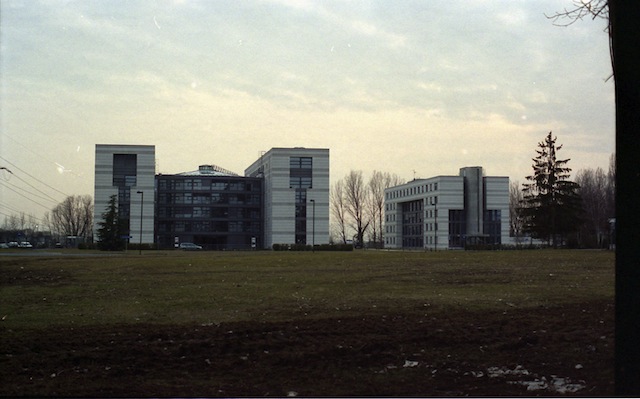
Le CERN is located on the border between France and Switzerland.
His arrest took place after extensive electronic surveillance. On November 9 2010, during a hearing before the Appellate Court, the conditions leading up to his arrest were detailed. The Court rejected his request for bail, a common position for terrorism cases. The judges write:
The need for him to remain in custody were revealed over the course of antecedent investigations conducted by specialists and notably via surveillance of electronic networks.
On November 23 2009, two weeks after the arrest, Figaro echoed the court’s findings in a chatty article about the ongoing investigation. With details about the anti-terrorist online tactics and direct quotes from security services, of course:
The trace was conducted using keywords thanks to software developed exclusively for the case. Infiltrating the discussion boards to take would-be terrorists by surprise.
The case of a lifetime
In addition to being one of the rare prosecutions of online terrorist activity, Adlène Hicheur is the only one to have been arrested in this conspiracy with terrorist organizations. Dominique Beyreuther, another of the defendant’s lawyers who has been on the case from the very beginning calls it “the case of a lifetime.” Despite the lack of any development in his case since his provisionary detention, Adlène remains behind bars.
“Adlène Hicheur cooperated with police and the court during his time in custody,” asserts Beyreuther. He confirmed having exchanged messages in the Spring of 2009 after a hospitalization. When his correspondent asked him what he thought of suicide attacks, Adlène Hicheur told him that he wasn’t in favor and was talking about attacks targeting Total or the 27th regiment of Annecy hunters. Without mentioning any specific dates or other details. For Patrick Baudouin, these messages, although worrying, do not convey any specific attack. Nothing indicates a potential, imminent terrorist act. There was no evidence to justify an arrest. An intention isn’t even clearly expressed. Baudouin concludes:
Police acted preventatively.
Words echoed by those of Bernard Squarcini, DCRI director, who declared: “Our [anti terrorist] system allows us to be able to anticipate and neutralize terrorist activities preventatively.”
French anti-terrorism campaigns have been criticized many times by Human Rights organizations. The NGO Human Rights Watch asserts in a 2008 report:
The overly vague formulation for identifying conspiracy crimes leads to convictions based on weak evidence or mere suspicion.
Three years after his arrest, Adlène Hicheur is still in custody despite numerous appeals by his lawyers. Each appeal is refused for very general reasons: prevent him from reconnecting with contacts, prevent potential infractions. At least every four months, he goes before a judge for a new interrogation. The latest one, at the beginning of July, lasted 20 minutes.
Photo credits FlickR CC by-nc-sa Su Morais / by-nc-sa Pixelhunt // Wikimedia Commons CC by-sa Rama
Translation from French: @lescailloux
💬 Discussion
No comments yet. Be the first to comment!