


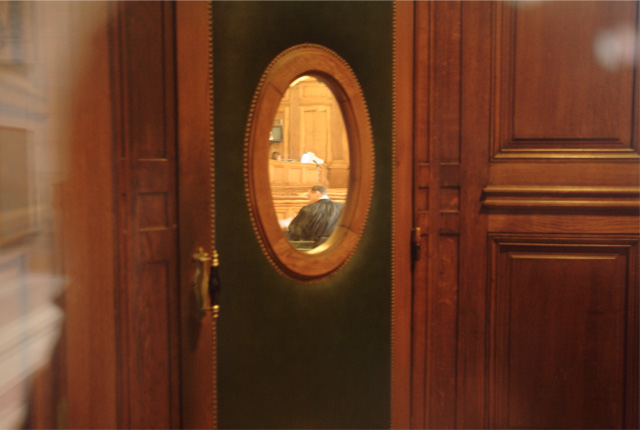
The verdict, when it came, was delivered in barely more than a whisper. Jacqueline Rebeyrotte, the senior of the three presiding judges, read the statement quickly and quietly, off microphone, before adjourning the session.
Four years in prison, and one year suspended. The verdict against Adlène Hicheur was not surprising, but it still came as a shock to his supporters. A physicist who had worked at the high profile CERN nuclear research centre, he was convicted of conspiracy in connection with a terrorist enterprise. He had exchanged emails with a correspondent identified by French intelligence services as Mustapha Debchi, who was presented by the prosecution as a member of Al-Qaida in the Islamic Maghreb (AQIM) in Algeria.
Before the hearing Patrick Baudouin, Hicheur’s lawyer, said he was worried, although a “surprise is always possible”. He criticised the trial that had taken place on March 30 and 31, chaired by magistrates that “did not ensure a balance between prosecution and defence,” seeming to side with the former.
Halim Hicheur, the brother of the physicist, was also worried, especially because of the “completely biased” trial process. A process which had surprised Adlène Hicheur, especially on the first day: Ms. Rebeyrotte had read out long passages and then asked him to respond, usually without asking for further explanations or precisions. The second day allowed for more exchanges, but Baudouin was unconvinced that correct procedure had been followed. “It’s a legal scandal and the logical conclusion of the steamroller of anti-terrorism justice,” he complained after the verdict was delivered.
At the centre of his criticism: a charge (of criminal conspiracy in connection with a terrorist enterprise) which has never rested on facts, “the most meagre shred of pre-operational context“. An abuse of process that ushered in the era of “pre-terrorism” to France, and is sure to fuel the propaganda of radical minds, according to the lawyer.
These injustices are bread and butter for terrorists. That’s extremely regrettable.
In the harshest of terms, Mr. Baudouin denounced the risk to individual freedoms and democracy from justice that is based only on statements made to individuals described as terrorists. Halim Hicheur focused his criticism against “a justice system which is no longer independent,” pointing to what he described as “a guilt determined from day one“.
The script was written in the offices of the DCRI [Central Directorate of Intelligence, "the French FBI" created by Nicolas Sarkozy in 2008]. It was then maintained by its director Bernard Squarcini and Frederic Péchenard [the General Director of the French National Police Force] who spoke in the media about a bomb that Adlène would have been ready to set off. At no time was this accusation made during the trial.
An equation of unknowns
Born in Sétif, north Algeria, Hicheur moved to France aged 1, growing up in the city of Vienne, just south of Lyon. He studied in the most prestigious European universities: the École Normale Supérieure in Lyon for his master’s, the Rutherport Appleton Laboratory in England for his doctorate. As a particle physicist, he worked at the European Organisation for Nuclear Research (CERN), including at the high profile Large Hadron Collider site.
He was suspected of planning terrorist attacks on French soil in liaison with AQIM, as a result of messages he posted on “Islamist forums” and emails exchanged with a user calling himself ‘Phoenix Shadow’ and an email address – [email protected] . The French intelligence services claim to have identified both as Mustapha Debchi, a member of the group AQIM operating from Algeria.
According to the defence, there was no evidence that Moustapha Debchi really was Phoenix Shadow. Right throughout the trial, the defence objected when the magistrate referred to Debchi as the sender of the messages. “We are presented with an equation of two unknowns a and x, and we are asked to say that a=x,” was how Hicheur himself put it during the trial.
Last year authorities in Switzerland dropped their investigation into Hicheur, finding no evidence of wrongdoing. He now walks with a cane as a result of herniated disk; his family claim his physical condition has deteriorated as a result of his long detention – last year he was attacked by another inmate. In December 2011, some 100 scientists addressed an open letter to then French president Nicolas Sarkozy questioning the justification for his detainment for over 500 days without charge.
Tangents
At his two-day trial in March, Jacqueline Rebeyrotte questioned Hicheur about his use of pseudonyms to protect his anonymity. “Why try to hide?” she asked, referring to investigators’ reports. “Using a pseudonym online has nothing to do with hiding,” replied Adlène Hicheur. “Certainly, but why resort to using encryption software, on the Ansar El Mujahedeen forum?” asked the judge. “It was widely used on Al-Fallujah [a forum described as "an Al-Qaida propaganda broadcast outlet" by investigators]. It was used for somewhat tangential political discussions about political or politico-military organisations,” replied Adlène Hicheur.
“Tangential” political discussions. Rebeyrotte noted the expression that Adlène Hicheur repeatedly used to qualify his exchanged messages with [email protected]. On February 24, he received a message from that address:
I would like (as a poor slave) to carry out operations in France and we lack lovers of HOUR ready for this…the only condition of those seeking martyrdom is that they are serious people.
Adlène Hicheur replied one week later:
My brother, you can’t know how much you have honoured me, or how happy your proposition made me, God bless you. But I will reply with the two following points.
Hicheur then expands on his notion of jihad, before finishing:
I hope you understand that I’m no coward, but I have in mind a general framework of the matter, to improve the skills in order to achieve these objectives.
In summary, continued Rebeyrotte, soleilde36 proposed the idea of suicide attacks to Hicheur, and he did not put a stop to the conversation there.
- How could someone in your position continue to have a discussion with someone such as soleilde36 after those propositions?
- I recognised a tangential attitude.
- That’s not saying much.
- It (my attitude) has already cost me 30 months in prison.
Questioned by his lawyer, he recognised that “these statements could be concerning“, as he had previously acknowledged before the magistrate. His lawyer Mr. Baudouin reminded the court of Hicheur’s stated opposition to the practise of suicide bombings, stated before the investigating judge on May 10, 2010.
That position failed to convince Guillaume Portenseigne, the state prosecutor, who denounced “the defendant’s total duplicity“, and accused him of never giving a straight answer to questions throughout the trial. On several occasions, he asked Hicheur to describe his beliefs.
- Are you a salafist jihadist Muslim?
- I am a Muslim, I have no chapel.
- Are you in favour of armed jihad?
- I understand people resisting an occupation.
Attempts to evade giving a straight answer, according to the state prosecutor. A rejection of “-ists”, according to Adlène Hicheur, ironically making mention of the risk of contracting “severe istitis“. Hicheur went on to denounce the “distortions and malfeasance of the highest order” which diminished the investigation and what he described as the investigators’ desperate efforts to make the crime stick.
In addition to the 35 emails exchanged, the prosecution relied on documents found at Hicheur’s house. Hicheur criticised the very rough translations that were made of these. In its ruling, the court noted that these documents “demonstrated the interest, even fascination, that Adlène Hicheur had in radical Islamism and the jihad warrior“. A question mark was also added to the accused’s explanation for the material.
Asked about the content of these documents, Adlène Hicheur said they were “related to the history of Islam” (?).
Hicheur’s “assiduous visiting of pro-jihadist sites, his participation and translation of documents, including documents from AQIM, to be published online” confirmed his interest in jihad, according to the court.
As to the charge of conspiracy, the defence emphasised that while his statements were occasionally worrying, they were limited to an exchange of opinions. According to the court, Adlène Hicheur was “a potential target for an individual belonging to a terrorist organisation, namely AQIM, without knowing what action would be taken on his suggestion“.
‘Humiliation’
The two and a half years that Adlène Hicheur has already spent in jail will be deducted from his four year sentence. The suspended year of his sentence was granted because of his Algerian origins. Sétif, where Hicheur was born, was the scene of massacre of Algerian civilians in 1945.
The Tribunal can not ignore the fact that Adlène Hicheur was born in Sétif, a city of sad memories, which could only strengthen his sense of injustice, humiliation before the fate of his fathers (sic).
The court further ordered that Hicheur should forfeit the more than €15,000 euros in cash and computer equipment found during searches of his home. Of the €15,000, €13, 000 was intended to finance the start of construction work in Algeria, where Adlène Hicheur had acquired land. Speaking after the verdict had been handed down, Mr. Baudouin denounced what he described as a “humiliation”.
The fruits of his research, his intellectual work, has been confiscated. He may be supported by over 400 physicists from around the world, including a Nobel Prize winner [Jack Steinberger], but it will be difficult for him to resume his professional life on his release. We feel that the intention is to break him, to humiliate him.
Image Credits: Vectorportal CC BY, Laurent Vautrin/Le Carton © via PictureTank
💬 Discussion
No comments yet. Be the first to comment!