
![[Infographic] Washington and the Shale Gas Lobby: More Than Just Good Friends?](https://owni.eu/uploads/owni/schiste-39d16bce.webp)
At the Department of Energy in Washington a new subcommittee on natural gas is making friends with shale gas, putting them on a collison course with a growing number of experts. In recent times American scientists have been growing increasingly worried. Interviewed by OWNI in August, Department of Energy spokeswoman Tiffany Edwards defended the complementarity of opinions within the subcommittee:
The subcommittee strikes a balance between experience and expertise, and each member is properly qualified in terms of practical and technical knowledge. Some have judged the panel to be too favourable to industry, others that it’s too favourable to the ecological lobby. We think we’ve been fair and that the diversity of opinions can only enhance the quality of our final conclusions.
That description appears questionable when we take a closer look at the makeup of a committee responsible for making decisions on shale gas extraction in the United States. Of the seven experts who form the committee, six are known to have links to the energy industry.
It’s the US government itself who orchestrated this homogenous mix. The Secretary of Energy, Steven Chu, formed the committee on May 5, part of the energy security plan announced by Barack Obama in March.
Behind the “academic” façade, industry paychecks
The subcommittee has lined up some prestigious references. Eminent professors from MIT and Stanford, two of the biggest universities in America, are seated next to former Clinton administration Department of Energy advisers and heads of NGO’s. But their respective résumés clearly show their ties with some major companies, all of whom have reason to be very interested in shale gas:
- Natural gas extraction companies (Schlumberger and Baker Hughes)
- Gas liquefaction specialists (Cheniere energy)
- Thermal energy and fossil fuel management companies (NRG Energy)
- Experts in geo-engineering and petroleum extraction techniques (GeoMechanics)
- Natural gas, environmental and strategic consultancy firms (Weston Solutions, IHS, Analysis group) ;
- Energy policy lobbyists (United States Energy Association).
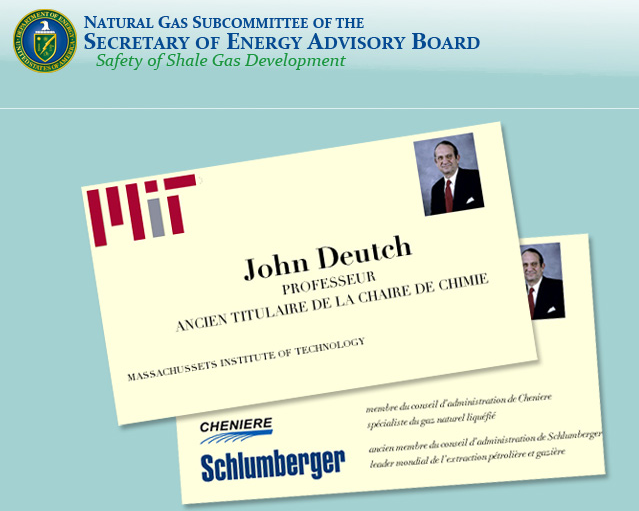
The subcommittee’s chairman, MIT professor John Deutch, has links with Schlumberger, a world leader in petroleum extraction, and Cheniere Energy, specialists in liquified gas (the only state in which shale gas is actually transportable). All that’s missing are the oil companies themselves (although a board member of their main lobby will be present) or indeed the giant Halliburton, inventor of the hydraulic fracturing that the subcommittee was convened to analyse.
Nothing new here…except grants
With breathtaking brazenness the committee has manipulated the modest recommendations of its August 11 report:
The Subcommittee shares the prevailing view that the risk of fracturing fluid leakage into drinking water sources through fractures made in deep shale reservoirs is remote. Nevertheless the Subcommittee believes there is no economic or technical reason to prevent public disclosure of all chemicals in fracturing fluids.
Not a word about the cracks in the wells, nothing about the incidents recorded all across the country, immortalized by the film Gasland and by mobilized Americans. As for regulation, the committee proposes systems that are already in place (a public database, regular monitoring of air quality near extraction sites) and some other ad hoc committees (looking into air, water, research and development of shale gas, all 100% guaranteed ”multi-sector actors and independent”). The icing on the cake is the request for assistance for the industry from the state:
We are conscious of the financial difficulties encountered by the State. But we realise the key role that it can play in modestly supporting research and development with regard to enviromental questions.
Scientists unhappy with a “business as usual” approach
In the face of this governmental initiative, a group of 22 university faculty members from 13 different states addressed a letter to the Secretary of Energy underlining the “lack of impartiality” shown in the composition of the scientific evaluation committee, and the explicit financial and professional connections of the members which are causing a bias in favor of shale gas extractors.
These conflicts of interest make it appear that the subcommittee is designed to serve industry at taxpayer expense rather than serving President Obama and the public with credible advice.
 A co-signer of the letter, Dr. Stanley Scobie of Binghamton University directly calls into question the way in which the committee evaluated shale gas risks.
The members of the subcommitte were for the most part high level managers, having arrived at those roles with well established positions on questions of politics and energy policy. Before and during their consultations it is recognised that they had ignored aspects of non-conventional gases that related to health risks. All that the committee chairman, John Deutch, has done is to seek the advice of a health expert who appears to be one of his buddies.
In recent months, the American scientific community has been under pressure: after forcing out a teacher seen as too critical of the shale gas industry, the University of Pittsburgh published a report in favor of this new energy source which is pockmarking Pennsylvania with wells. It just so happens that the study was funded to the tune of $100 000 by a group of companies operating in those wells. Dr. Scobie highlights the absurdity of a situation where major universities that are not funded by private business are still required to apply for public grants from organizations in favor of developing these new resources.
Standing on the same potential goldmine as Pennyslvania (the Marcellus shale gas deposit), the State of New York declared a three-year moratorium to look at the issue in depth before allowing drilling. It’s a decentralised option that some scientists are praising, highlighting the existence of a National Academy of Science or EPA evaluation committees as essential to ensuring the independence of members of future committees. That approach would require putting the brakes on the full speed ahead mentality for shale gas that has spread from Texas to Lake Michigan. But it’s an alternative that will likely do little to hamper the march of the “business as usual” brigade. 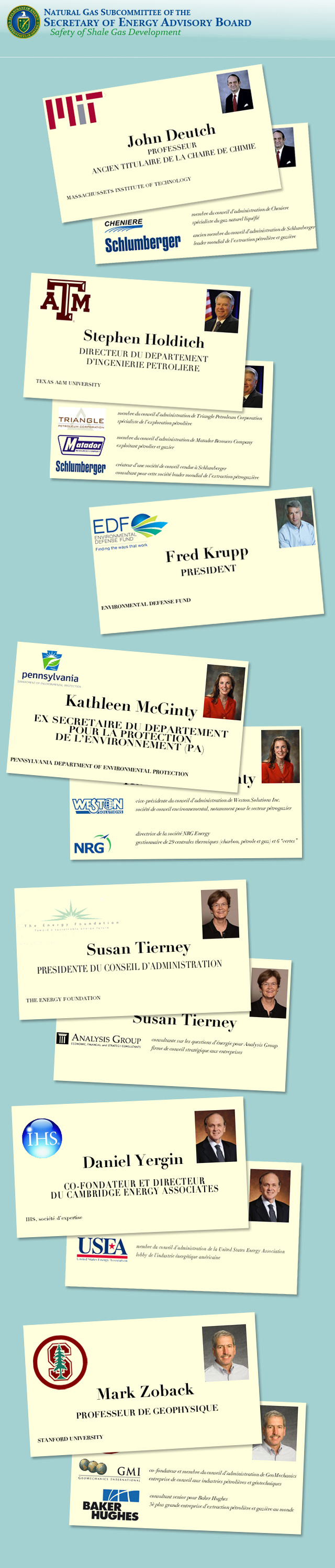
Illustrations: Flickr CC Pay No Mind, ehpien, Infographic Sylvain Lapoix & Marion Boucharlat
Translation from French: @lescailloux & @aidanmacguill
💬 Discussion
No comments yet. Be the first to comment!