
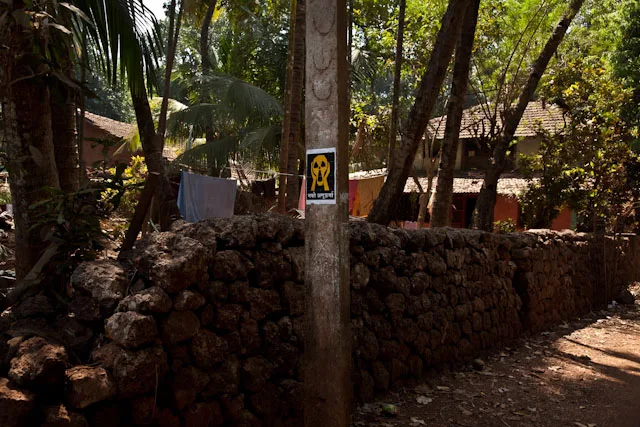
Madban, India. ©Micha Patault/Picture Tank
The Indian town of Jaitapur lies just south of Mumbai, on the coast of the Arabian Sea, in an area of high seismic activity. Nearby, energy multinational Areva has begun work on the construction of two third-generation EPR nuclear reactors. They could be operational by as early as 2014. The site is about 110 miles from the epicenter of the earthquake which occured at Koyna in 1967 – an earthquake which registered 6.3 on the Richter scale.
Fears that a similar earthquake might damage future EPR reactors seem to have been sidelined so far – despite protests from local residents that began in April 2011.
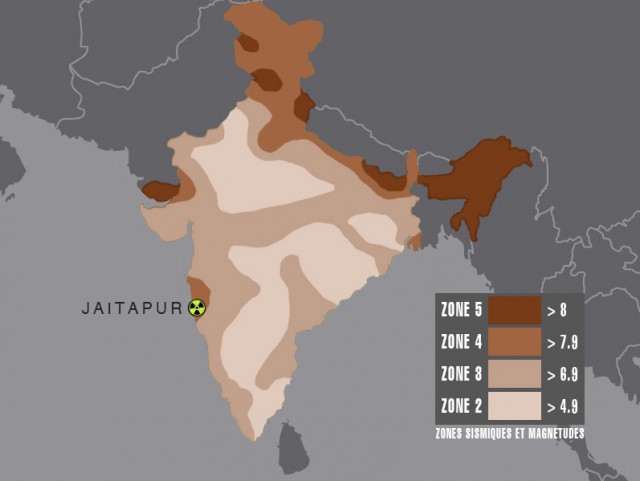
6 on the Richter scale
In recent weeks, however, research has drawn new attention to the seriousness of the risk. It comes in the shape of a geological survey carried out by Roger Bilham, a professor at the University of Colorado, and Vinod K. Gaur, former director of the Indian Institute of Geophysics. It was published on November 25 of last year in the journal Current Science, a publication produced in partnership with the Academy of Sciences, New Delhi.
According to their report:
Since Jaitapur lies in the same compressional stress regime that has been responsible for generating both the Latur and Koyna eartquakes in the past five decades, it can be argued that a similar sized earthquake could possibly occur directly beneath the power plant.
The report concludes that the occurrence of such a catastrophe in the Jaïtapur region is possible within the lifetime of any power plant situated there. That conclusion is not one shared by Areva’s local partner, the state-owned Nuclear Power Corporation of India Limited (NPCIL), the future operator of the reactors. In a statement the group disputes the seismicity of the area, making reference to other studies carried out in the region.
In France, officials from Areva don’t appear to be unduly concerned. Jérôme Rosso, press officer for the nuclear giant, explains:
It’s for the Indian authorities to decide where they wish to set up the plants. The risk of seismic activity is taken into account by Areva in the specifications and therefore in the design of the reactors.
A lucrative market
The decision to locate the nuclear reactors in this region was taken prior to the Fukushima disaster and the lessons that have emerged in its wake. In September 2008, while India was seeking to increase its energy production to support its incredible domestic growth, the French government signed an agreement on civil nuclear cooperation. The purpose of this Franco-Indian agreement was to export French EPR stations and the fuel needed to power them. In this context, Jaitapur was seen as the centerpiece of India’s new nuclear fleet.
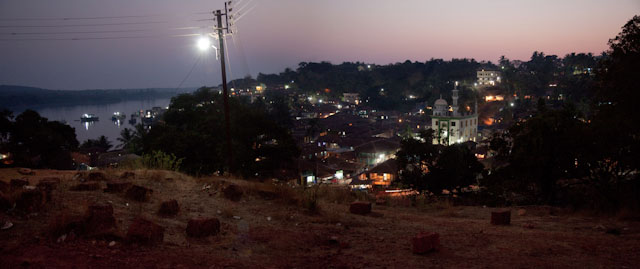
The Jaitapur plateau viewed from the village of Sakrinate. ©Micha Patault/Picture Tank
A few months later, in February 2009, the ‘Memorandum of Understanding‘ between the two countries was agreed upon. It provided for the construction of two to six 1650 megawatt EPR reactors in Jaitapur. During a visit to India in December 2010 by Nicolas Sarkozy, contracts were signed by Indian Prime Minister Manmohan Singh and the French President. The framework agreements for the two EPR reactors at Jaitapur were assigned to Areva.
India, with its billion inhabitants, parliamentary democracy and growth of over 7% even after the 2008 crisis, is an attractive market for French nuclear technology. It will deliver a lucrative contract to Areva worth somewhere between €5 and €7 billion euros, depending on the implementation of various commercial options. At Areva, Jérôme Rosso explains:
Discussions are still underway concerning the commercial contract. An agreement was signed in December and a feasibility study was carried out for the two EPR reactors. NPCIL had clearly indicated they were awaiting the conclusions of the Nuclear Safety Agency1 concerning safety and the latter announced in January the modifications and requirements to be imposed on EDF and Areva. NPCIL said in early January that they wanted to sign by December 2012. But as we are in the middle of negotiations, we can not disclose the amount of the final contract.
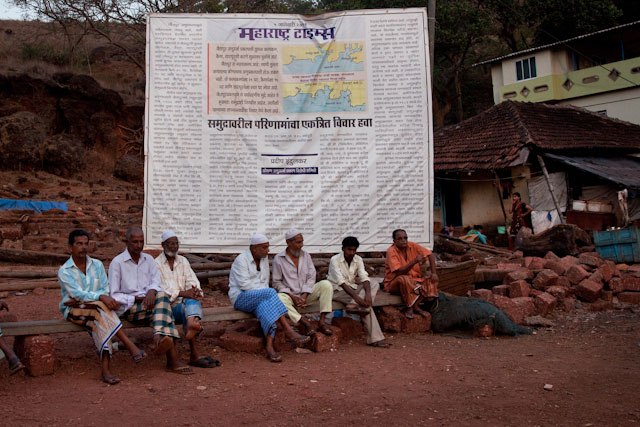
A reproduction of an article from the Maharashtra Times in the centre of the village of Sakrinate. In it the journalist Pradeep Indulkar explains some of the effects of nucelar power plants. ©Micha Patault/Picture Tank
For the moment, commercial interests are being held up by Indian regulations regarding supplier liability in the case of accident and victim compensation. A law is being discussed in the Indian Parliament that would force Areva to pick up the tab in the event of compensation cases. However, sources inside Areva have told OWNI:
This is a matter of civil nuclear liability: in the Indian case, obviously, we will apply Indian law. For the moment, the wording of the law is being studied and modifications can still be made in Parliament.
But Bernard Bigot, chairman of the Atomic Energy Commission (CEA), visited India in December 2011 in an attempt to address the problem:
In India, the law on nuclear liability poses a problem. Following the Bhopal accident2 (the law) defers responsibility to the supplier, contrary to the tradition in the nuclear sector of assigning this responsibility to the operator – which is normal, since (the operator) is on the front line. So I went to this country to explain to our Indian partners why their choice was not reasonable. I do not believe that, in doing this, I am acting beyond my role.
Beyond the diplomatic round trips, activist organizations are denouncing the lack of financial transparency in the agreements. According to Greenpeace, the initial contract negotiated by the two nuclear industry companies was worth up to €5.4 billion euros for both reactors, with an Indian government debt to equity ratio if 70%/30%.
Photography by © Micha Patault /Picture Tank, all rights reserved.
Map of India created by Micha Patault.
Cover image: Flickr CC Truthout.org (BY-NC-SA)
💬 Discussion
No comments yet. Be the first to comment!