
Advertisers are having a field day with the Arab Spring, “extending the battlefield” so that they can put every possible aspect of the revolution up for sale. In Ted Swedenburg’s blog post, soberly entitled ‘Coke and Pepsi and the Egyptian Revolution‘, he analyses the latest Coke and Pepsi ads. In keeping with their eternal commercial rivalry, the two American soda giants are now competing to make the most of the charms of the Arab revolution.
Pepsi begins with some middle class young people (presumably revolutionaries) who are getting all their ideas from surfing on modern technology (computers and cell phones), and who proceed to literally “re-color the city”. The allusion to the January 25 revolution, although a bit subiminal, doesn’t take long to arrive, beginning with the image of a journalist on television reporting from in front of an urban landscape. Right at the end of the ad there is an implicit link to the revolution with the image of a character waving from his balcony to a group assembled below that could very well be revolutionary (but who are never quite identified)…
Coca Cola also runs with the color metaphor, with their story of downtown Cairo emerging little by little from the gloom as they “Make Tomorrow Better” (the slogan at the end). Here again, it’s at the end of the ad that the political events are more clearly evoked when, above a background of speeches demanding the impossible, the camera reveals the now ubiquitous image of Tahrir Square.
Of course, everything is non-violent and beautiful in the magical world of advertisements! And of course it’s far from the first time that advertisers have plundered inspirational political revolutions in general, or counter-culture movements in particular (Swedenburg recalls how Coke and Pepsi also used the 1960’s American underground movement to their advantage too).
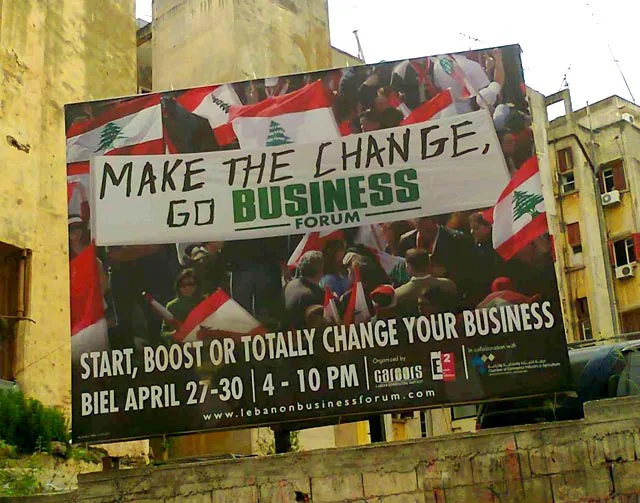
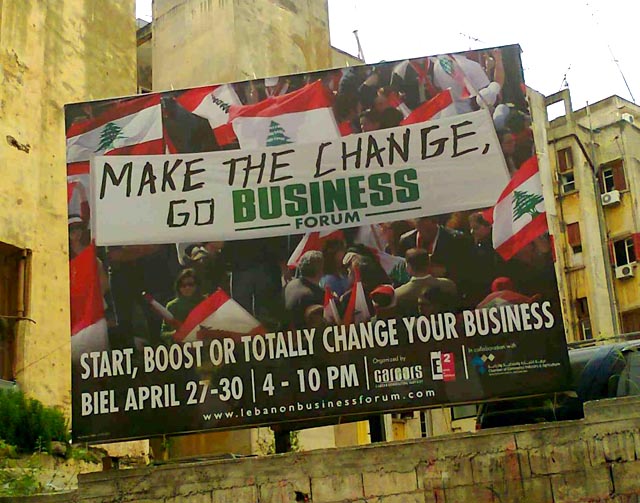
The revolution, an alternative to business forums
At least in the American example the reappropriation took place a posteriori. It’s maybe a little shocking to discover in the centre of Beirut in April, while the fires of the Arab Spring were still smouldering, this advertisement which tries to associate participating in a business forum with protesting in the streets…
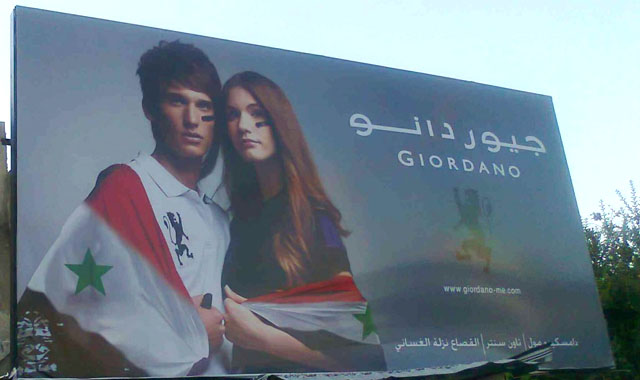
But truly appalling is this advertisement in the centre of the Syrian capital. It undoubtedly alludes to the dress code of football supporters, but also brings to mind pro-regime protestors even while the “events” (the oppression of opposition protesters by the regime) have likely led to the deaths of more than 2000 people…
By contrast, this video by the young Lebanese singer Sijal Hachem for her song Khalas is more dumb than nasty, featuring beautiful masked men standing behind flaming tires and barbed wire. These extraordinary creatures can’t decide if they’re repressing or seducing (like the Egyptian army?). The climax of this (hopefully deliberate) erotic metaphor comes when a powerful jet of water bursts from a hose, “dampening the hubris” of the protestors! It all ends with an interrogation, especially troubling when you consider the methods too often used in the region.
The pairing of advertising and politics is nothing new in the Arab world (2005 being another landmark year). Once again, we have regimes choosing between good old fashioned propaganda and modern political communication with its spin doctors. Home to many Arab advertising “creatives” and a large number of international advertising agencies, Lebanon was one of the frontlines where opposing political movements fought out their interposing media battles.
Lebanon is still the place where this sort of political communication has not only been derided but also recycled, deviating from its political objectives to return to its original purpose, to advertise consumer products.
As the author suggests in this article on Muslimah Media Watch, the Arab Spring is not only being televised, but also commercialised and sexualised!
This article originally published on Culture et Politique arabes under the title: “Dieu que la révolution est jolie ! Le printemps arabe© est en vente…”
translation from French: @lescailloux & @aidanmacguill
💬 Discussion
No comments yet. Be the first to comment!