
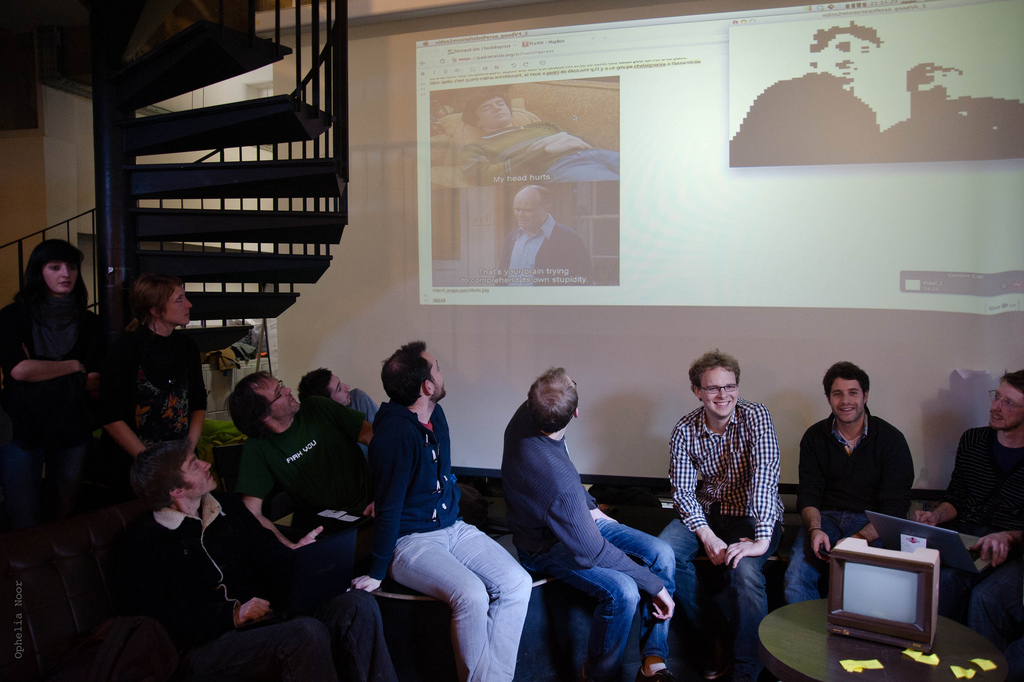
Last week, OWNI co-organized Hack The Press 2 alongside Silicon Maniacs, La Cantine, Regards Citoyens, Epitech and with the support of La Netscouade. This friendly data journalism competition pitted seven multidisciplinary teams of developers, designers and journalists against each other. Their mission: to build in one day an application based around data on French elected representatives (deputies and senators)from Regards Citoyens (it’s an election year here in France).
Following this marathon session, the teams submitted their projects to a public vote. In the end it was “Cinq à sept” (Five to Seven), with their project Amitiés internationales (International Alliances), who finally lifted the coveted Golden Minitel trophy.
Towards a Meta-Newsroom
The evening was not without disappointment, with projects not quite completed by the deadline, and most were not ready to be released online. But what we’ll take away most of all is the giddy atmosphere of the day, the standard and rich potential of the ideas and the new interests that were sparked. Some of the participants also expressed their desire to continue with their projects at a later date, more proof that the idea of a meta-newsroom – where colleagues working at rival organizations can collaborate together on external projects – is not necessarily a pipe dream.
Another highlight was the call for more open data which came at the end of the conference examining how data journalists should cover the upcoming French presidential election.
Many participants used the event to voice their concerns about the ongoing difficulties with accessing data, data which will be essential to effectively carrying their work as data journalists during the presidential election and legislative elections that will follow it.
All the work is presented in detail in French, and we’ve provided a brief summary in English of each project.
Team 1: Poleetic
Poleetic’s half-joking, half-serious application took the thinking behind Meetic and applied it to parliament. Will you find the deputy of your dreams? A fun way to tackle the issue of the social uniformity of our representatives.
Team 2: Watchdog
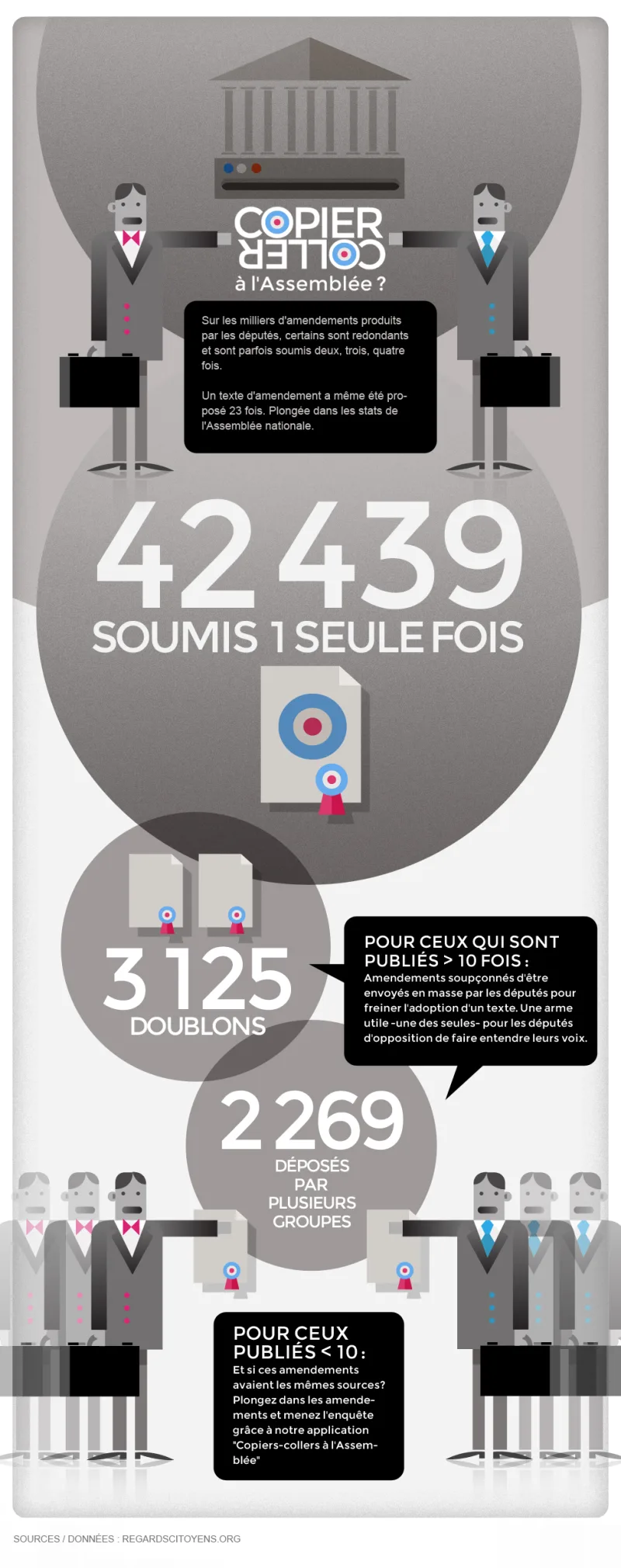
Team 2 compared similar amendments proposed by parliament: what area do they relate to, who proposed them, etc. Their work was collected on a site, Qui copie qui (Who’s copying who). It includes a visualization (see below) and a tool to navigate through similar amendments, all presented via a Wordpress blog equipped with a search engine.

Team 3: CumuloNimbus
An application to measure the impact that holding multiple offices has on representatives’ activity, presented in the document below.
Team 4: Awerty
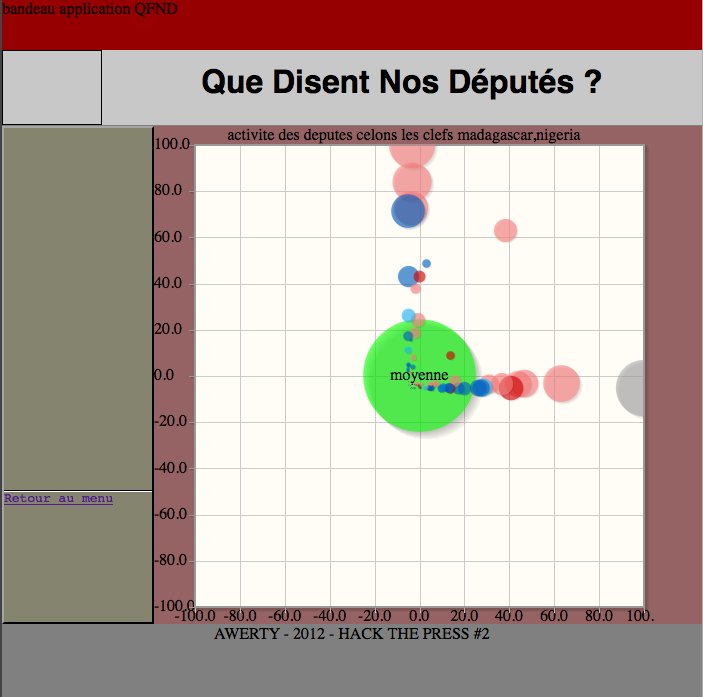
A tool for evaluating the activity of a representative in a given area, which the user can choose..
Team 5: Five to Seven
The winners of Hack The Press 2 focused on the diplomatic activity of elected representatives: to which international alliances do they belong and to what extent does the size of the groups reflect economic and cultural ties?
Team 6: Datafluence
An application to understand how the news is born: is it influenced by the parliamentary agenda, or vice versa?

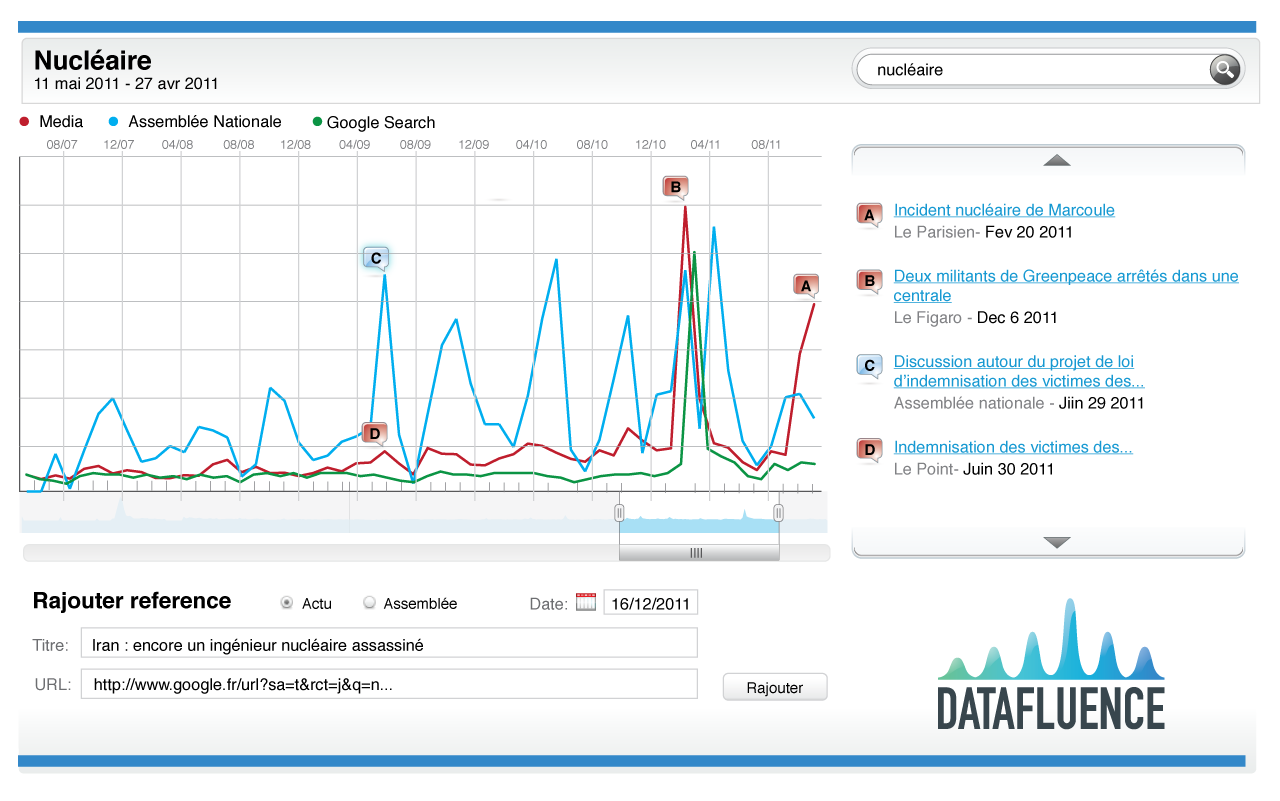
“Are journalists talking about what really interests the public? Are elected representatives the slaves of the news cycle? Is the deficit between the intelligentsia and the general public real? Is there a gap between media, politicians and public opinion and, if it exists, how can we explain this?
We wanted to question the influences, relationships and the interconnections between the political agenda, the media agenda and the interests of the general public. For this, we dreamt up what could be described as a Storify for data.”
Team 7: Tetalab / Carredinfo (Toulouse)
The team from Toulouse reflected on the work of moonlighting parliamentarians: is it the case that those who accumulate offices outside the assembly also accumulate extra responsibilities within the assembly (study groups, working groups, alliances)?

“We started with the idea of comparing the holding of multiple offices and parliamentary activity. We focused on the deputies, the premise being that the more emphasis is placed on the number of offices and participation in groups, the less is placed on real parliamentary activity’”.
Photos & illustrations :
CC Ophelia Noor for OWNI; © Jacob Khrist, photojournalist ; Instagrams by Gayané Adourian and Nicolas Loubet for Knowtex; Drawings by Benoit Crouzet for Knowtex.
The site of Hack The Press
💬 Discussion
No comments yet. Be the first to comment!