
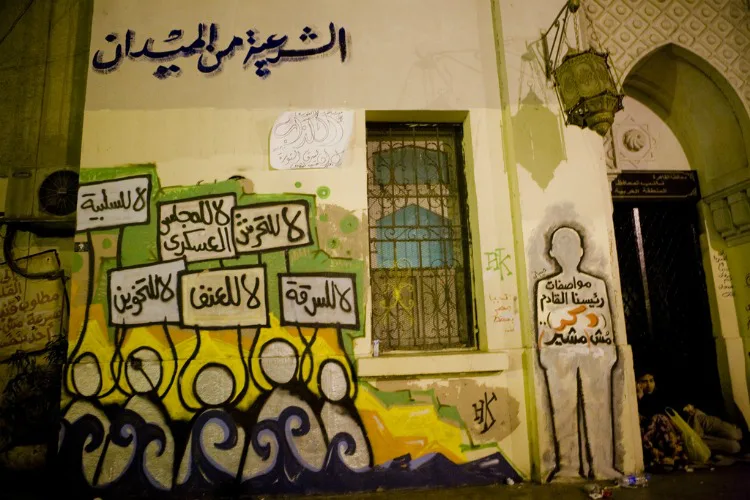
The creativity of the Egyptian revolution – often marked by a sort of national humor, viewed by many Arabs as a local specialty – has made the city its theater, with Tahrir Square the centre stage. The activists have taken over the urban space, in the truest meaning of the term, writing their slogans and pictures on the walls of public places.
It’s a battle field, with activist artists organizing themselves into commando units, generally working at night, to install their creations in strategically selected locations. (They choose) places that are particularly popular, but also places that delineate the boundaries of the area that’s “under the control” of the insurgency. Security forces decide whether or not to turn a blind eye, depending on the situation.
The beginning of the first wave of mobilisation in January 2011 was marked by a piece of work by the artist Ganzeer that payed tribute to Islam Raafat, one of the first victims of the revolution. More recently, the events that took place at rue Mohamed Mahmoud, just before the elections, were preceded by the arrest of many artists. As the Egyptian Civil Code was not written with this type of ‘infraction’ in mind, the troublemakers had to be prosecuted under various pretexts. Ganzeer was arrested for “having painted a flag which undermined public safety”! Generally speaking artists end up being released sooner rather than later, under caution…
They also have a presence on the web, especially on social networks which let them know when they need to mobilise if they are in danger. Graphic designers, multimedia artists and activists have put their professional expertise to the service of political resistance. They use digital technology to publicize their struggle, but also to create a virtual library of image resources that are then reproduced, or not, by other protesters on walls, on protest placards, on T-shirts, etc..
How does one turn a virtual revolution – both “potential” and “digital” – into a popular uprising? These graphics that have accompanied the Egyptian revolution offer the artists’ response to this central issue for opposition movements, by giving an example of how the potential of digital workflows can be embodied in the physical reality of the urban space, right onto Cairo’s concrete walls.
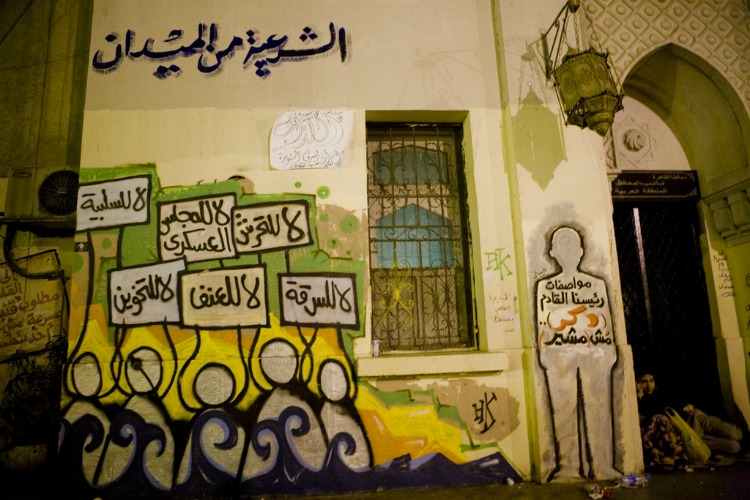 Mugamma, Tahrir Square, Cairo.
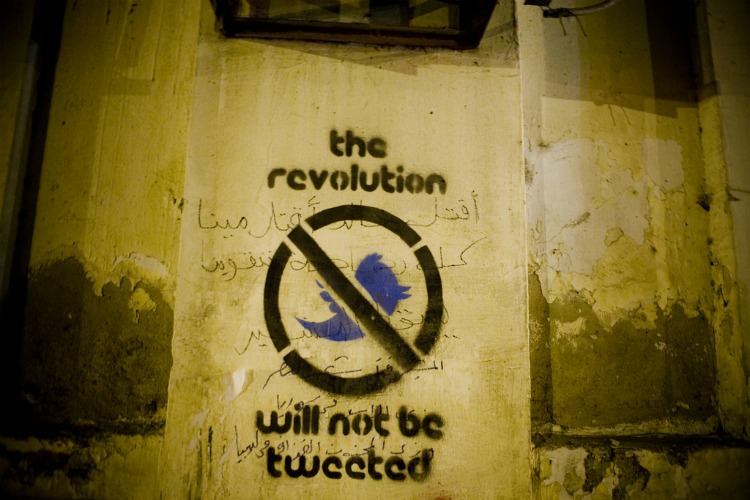 “The Revolution Will Not Be Tweeted”, Qasr el-Aini Street, Cairo.
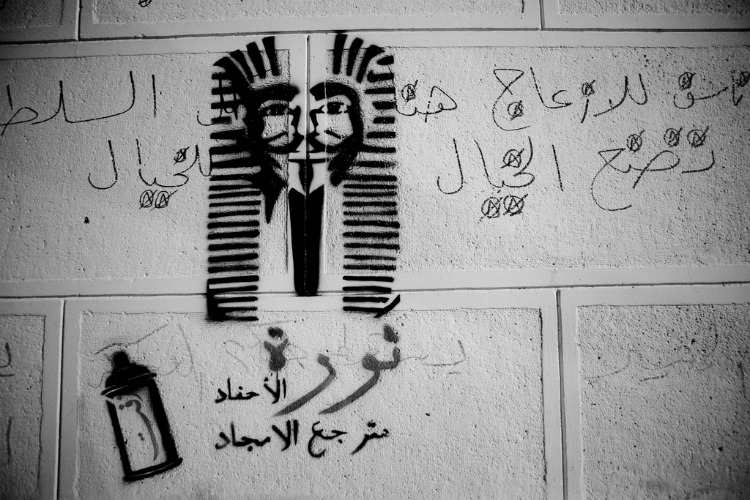 Egyptian Anonymous at #OccupyCabinet, Cairo.
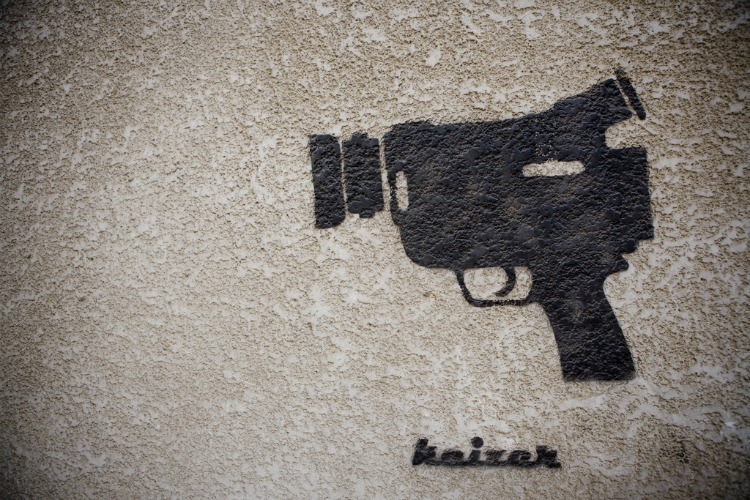 “Your camera is your weapon”, Saleh Selim Street, Zamalek, Cairo.
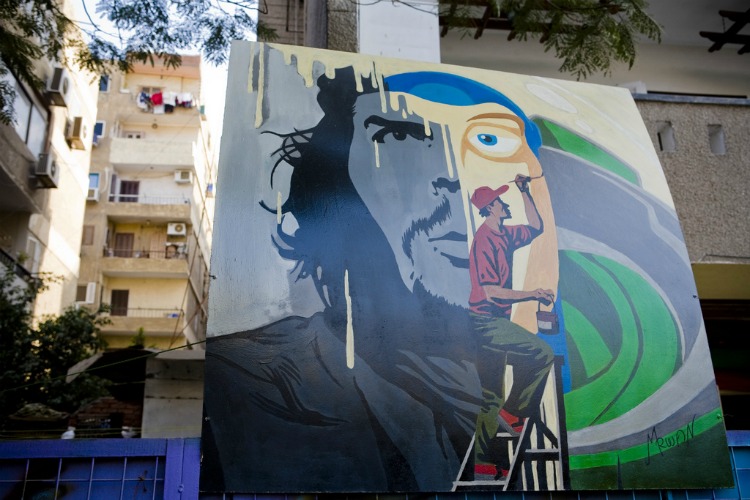 “Che”, mural on a children’s nursery.
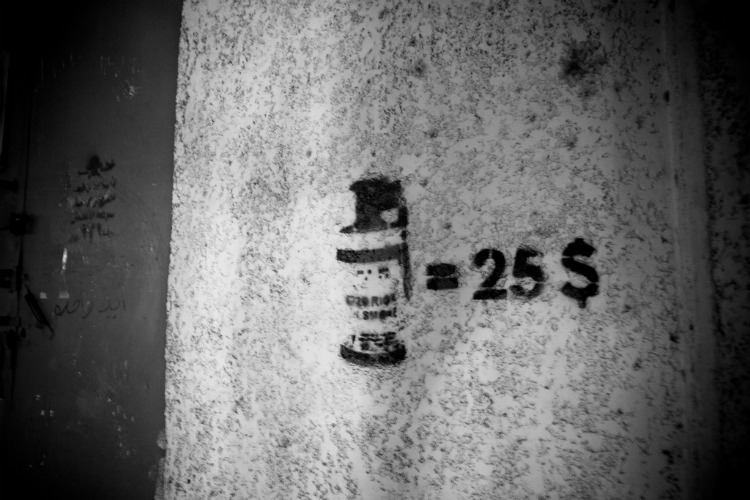 “Tear Gas Canister = $25″, Mohamed Mahmoud Street, Cairo.
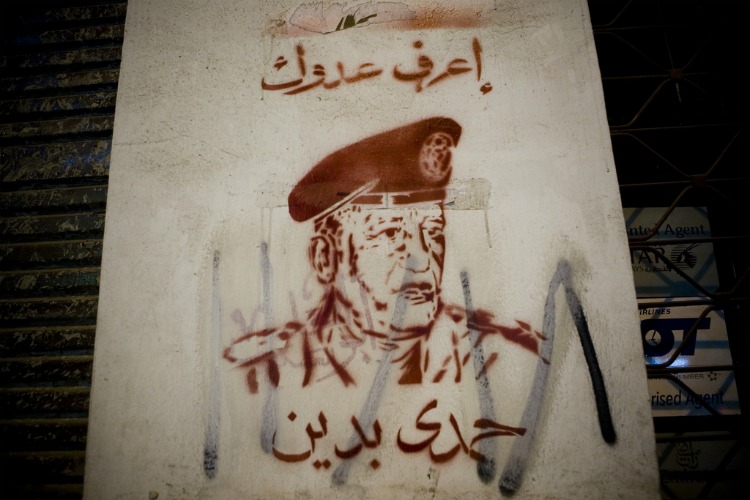 Stencil in Talaat Harb Street depicting General Hamdi Badeen, the military police chief, with the slogan: “Know thy enemy”.
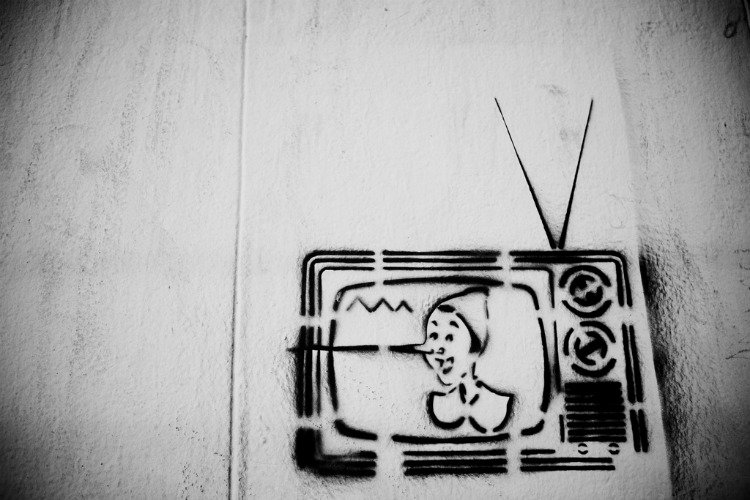 El-Gezeera Street, Zamalek.
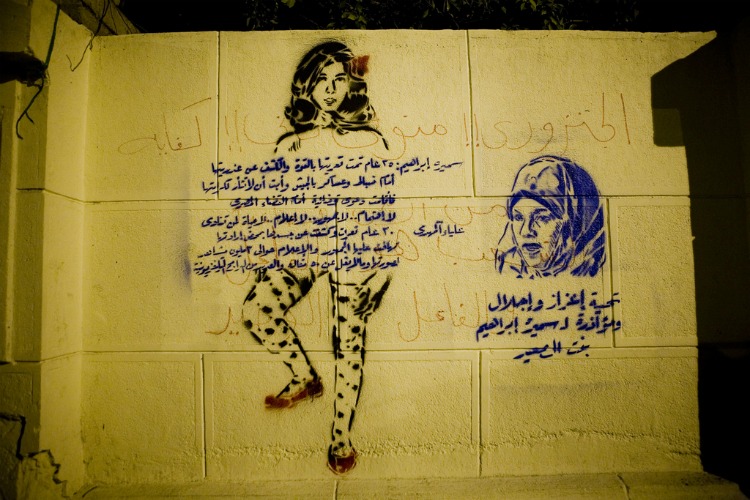 At #OccupyCabinet. Alia El Mahdy (the nude revolutionary) & Samira Ibrahim, who is taking SCAF (the Supreme Council of Armed Forces) to trial over her being subjected to virginity tests in March. Roughly translated the text states that Samira was forced to take off her clothes & subjected to a virginity test by soldiers. Alia El Mahdy took off her clothes willingly and her nude photos were widely viewed. (Source)
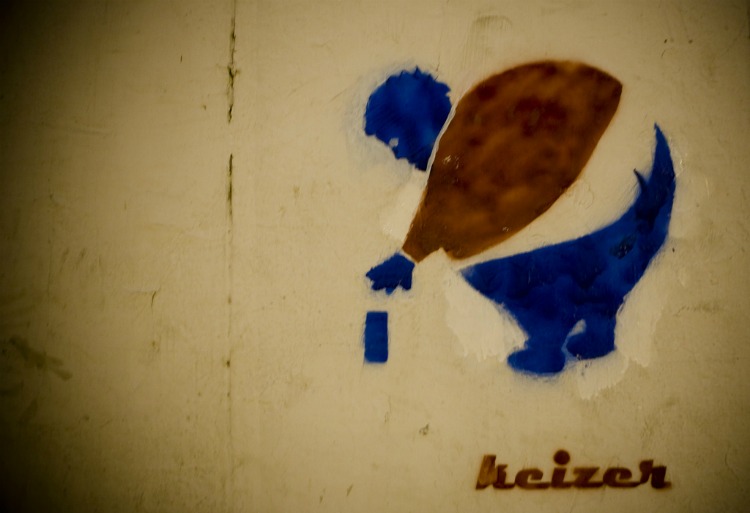 A new look for the Pepsi logo. El-Gezeera Street, Zamalek
________________________________________________________________________________________
Image Credits: Flickr CC Hossam el-Hamalawy (BY-NC-SA).
This article is an edited version of Virtual et concrete : petite contribution à la création graphique de la révolution égyptienne which originally appeared on Cultures et Politique Arabes and Owni.fr.
💬 Discussion
No comments yet. Be the first to comment!