
On January 28, 2011, the Egyptian government cut the Internet. A black out of such magnitude was unprecedented. Behind the scenes, a small group of citizens from around the world tried to find alternative means of communication for Egyptians. At the front lines was Telecomix – an entity that seemingly has no boundaries.
On July 8, thousands of demonstrators flooded Tahrir Square in protest. Five months after the fall of Hosni Moubarak, people continue to protest their discontent over the army’s inability to implement the promised reforms. On Thursday evening, hundreds of young people sang:
Anas al-Fiqqi was declared innocent. Have you ever heard such boldfaced lies?
Al-Fiqqi, previous intelligence Minster, was acquitted on July 5 after having been accused of embezzling public money to finance his party’s election campaigns (along with Moubarak’s campaigns). The same case included two other ex-ministers who equally benifitted from an acquittal.
Beyond just simply denouncing the verdict, the demonstrations’ principal goal was to call for a public trial for Hosni Moubarak and to justly deal with those related to the “Martyrs of the Revolution.” In late May, the former head of state (who still remains in Sharm el-Sheikh hospital) received the first conviction, a pharaonic fine of 23 million euros to compensate for lost revenues following his decision to cut off Internet access and mobile phones in Egypt.
On January 28, 2011, access providers complied with the Egyptian governments injunctions to suspend Internet services, causing a 90% decline in traffic. “I’ve never seen a cut to this extent before. It’s like if you redrew a map of the globe, Egyptians wouldn’t be there anymore,” said Jim Cowie, chief technology officer at Renesys (an American company that analyzes Internet traffic).
Out of 80 million inhabitants, 20 million Internet users and 55 million mobile phone users were deprived of communication for five days. Yet only a few hours were needed for a new kind of mobilization to occur, which carried the objective of literally hacking through the unilateral black out and finding ways for Egyptians to communicate again.
No precise plan of action
At the front lines of this movements was Telecomix. Tele who? To try to define this rather idiosyncratic entity, we have to start by identifying what it isn’t. Telecomix isn’t an organization – it doesn’t have any leaders, or a common voice. In short, Telecomix doesn’t have a precise plan of action.
Telecomix is a disorganization without a formal adhesion system or bureaucracy in which a scattered group of volunteers deliver technical support, explains Peter Fein, all the way from Washington, D.C.
For 9 months, Fein (programmer, biker, and yoga amateur) volunteered full-time as a Telecomix agent. Left to live off of his savings, he insists that he is not a spokesperson and he only speaks on his own behalf. At various conferences, he often shows a video of the
As you can see, a flame-thrower is used to disperse the protestors. What I find incredible, isn’t so much that Geneva convention violations as much as the telephones used to film. The people are trying desperately to show the world what is happening. This is why information needs to be free, open, and directly accessible starting with this portable phone video. If we can’t see, we can’t react.
Fein and other Telecomix agents offered technical supports to citizens affected by the Middle Eastern revolts for several months. The support was there in advance, ready to act at the first angry murmurs in Tunisia when Ben Ali attempted to block videos from being published on Facebook. Without a doubt, their actions in Egypt will remain highly renowned.
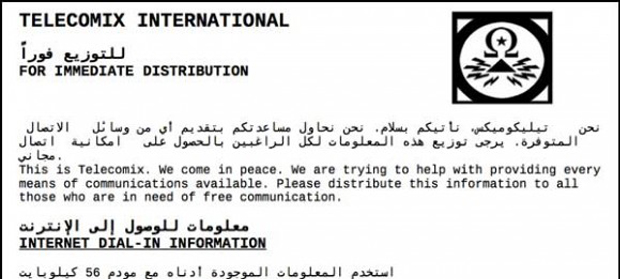
There were two parts to the operation. The first concerned the moment when only certain websites were blocked, like Twitter and Facebook. At that moment, we set up mirrors and proxys so that certain videos could be uploaded and published, and we used Tor and VPN. We also had some Egyptians on our IRC chat and we proposed to tweet on their behalf. On January 28, when the Internet was definitively cut, everything became much more challenging. We tried several different methods for alternative communication. We tried to communicate via radio waves, but that wasn’t very effective. Ultimately what worked the best was the setup of dial-up modems. We set up hundreds of these devices thanks to the help of Internet providers. Today, these numbers are used in Syria – we used the fax numbers to send treatments for those who had been tear gassed.
The Egyptians who use this network are thrilled to have the helping hand. Yet Telecomix agents don’t want to know too much about who they’re helping. Telecomix works without rules, yet the security of those helped is paramount.
We do reflect on the unwritten principals dictating the right way to do these things. We’re providing solutions to the peoples’ needs, and that is what motivates me.
A responsible do-ocracy
Telecomix agents never conceived a set, long-term plan for their actions in Egypt or elsewhere. On their IRC, Telecomix presents itself as a do-ocracy, a flexible structure where each individual assigns tasks and acts responsibly. “Having ideas is enough, then others can chime in to help. Nobody has seen the entirety of our projects,” explains Fo0 and Menwe. Pete Fein adds:
It’s all very ad hoc. During Egypt, there were 500 people on the Telecomix IRC. As I speak, there are about 170. It’s fluid. The idea of a do-ocracy comes from Burning Man, and works against the ideals of a bureaucracy. We don’t want order, actions are taken by doing things.
Telecomix is a hybrid. There are hackers, of course, but also “sociology professors, students, politicians. You aren’t obliged to be a programmer. You have to know how to use a computer, of course, but from there, we’ll teach you the rest.”
In an IRC chatroom, someone known as an “ehj” who works with the European parliament confirmed Peter Fein’s sentiment. Another person known as Tomato – a German “agent” – summarized in a few brief sentences the essence of Telecomix:
Telecomix is an idea. The idea is open communication through whatever method necessary.
Telecomix’s doesn’t limit itself to the Middle East. Cryptography lessons have already been given in Belarus, and workshops were held for NGOs in Geneva at a conference organized by Reporters Without Borders during The World Against Cyber-Censorship day.
“The Internet is an autonomous zone”
According to Pete Fein, the Internet is “In the most general way, under attack. This changes from one country to another. In Egypt, it was cut. In the United States, the issue surrounds surveillance. In China, it’s the extreme. The sophistication of the censorship tools are just stupefying. In European countries, the proposed laws to monitor traffic and control networks are worrying. It has only been 15 years since people had Internet access. It’s never been the Wild West. The network developed its own ethics and cultural norms, which vary from one place to another. All of this happened without government control.
The Internet was an autonomous zone where people could create their own norms, and now others want to go back in time and seize the network. We shouldn’t be surprised. The same thing has been happening for 500 years. At one time, the English government decided to grant exclusive licenses to certain guilds, so that they alone could practice their trade. It took thirty years for the government to regulate radio after its invention, to the dismay of users. The Internet is undergoing the same thing – every time someone gets their hands on a communication tool, it gives them ideas and the authorities become threatened.”
Derived straight from the government’s attempts to take over the Internet, Telecomix agents’ first meetings on IRC supposedly took place when the Telecoms Package (a set of measures proposed by the European Commission to regulate communications networks and services) was being adopted in the European Parliament. Ludens describes:
In the beginning, it was all about lobbying in Europe, and sensitizing public opinion. Later more people with technical expertise joined the cause, and that’s when we started to hack.
Parallel with the Anonymous
We could try to compare Telecomix and Anonymous, the organization known for its fight against Scientology and blocking Visa and MasterCard sites after they refused to process donations for WikiLeaks near the end of 2010.
There are comparable points, says Fein. They operate also with the do-ocracy mindset and, like us, they support the freedom of expression. I linger from time to time on their IRC rooms – I observe what’s going on, but I’m not active. Sometimes we’re able to collaborate. At the end of the day, Telecomix and Anonymous are both working to preserve an open Internet, but we approach the task differently. They raise red flags and point. We create tools that are useful.
Pete Fein is stepping back from this endeavor, although he would like to continue part-time at Telecomix and try to find investments for another project. “I am not a programmer, I don’t know how to do that. It’s a fantastic thing that I was able to work with Telecomix. I have certain technical competencies, and it’s a gift to be able to use these abilities to help people communicate. Hacking for freedom, that’s what it is.”
Photo credits: JB_Graphics
Pete Fein’s blog: http://blog.wearpants.org/tag/telecomix/
Article initially published on Geek Politics with the title “Telecomix, les empêcheurs de censurer en rond”
💬 Discussion
No comments yet. Be the first to comment!