
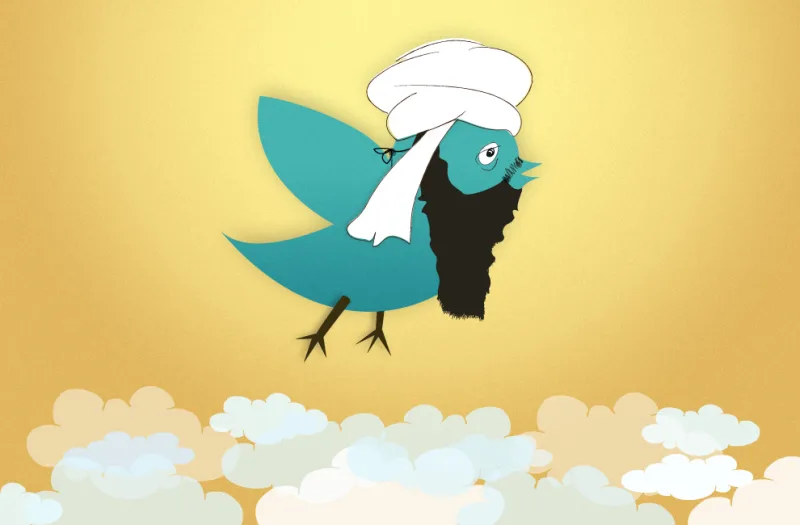

Three French terrorists shot dead by Afghan soldier inside Shamshad named base in Tagab district (Kapisa) at 06:30 am today.
The announcement was made by a Taliban source, in English, on his Twitter account. On the same day the French defense minister, Gérard Longuet, confirmed the death of two French legionnaires, not three as claimed by the jihadist organization’s spokesman.
Tweetclash
NATO forces, which have been engaged in Afghanistan for the last 10 years, are not letting jihadists have things all their own way on micro-blogging sites. The account of the International Security Assistance Force (ISAF) regularly replies to the tweets of the jihadists. Indeed in late December the ISAF advised, with more than a hint of irony, the jihadists to replace a link in one of their tweets. The Taliban had claimed that a NATO helicopter had crashed having come under mujahideen fire. In their tweet, the ISAF linked to an official statement from their site, which claimed the helicopter had carried out “a precautionary landing due to mechanical problems“.
This type of public provocation between the Taliban and NATO has become a regular occurrence, resulting in some truculent exchanges:


Al-Qaida in Somalia
@ABalkhi is not the only Taliban faction, nor the only jihadist group, to have taken to Twitter. The Shabab, a Somali group affiliated with Al-Qaida, occasionally use the service to rebuke the Kenyan military. The account HSMPress, for Harakat Al-Shabaab al Mujahideen (Movement of Young Mujahideen) responded to a tweet from a Kenyan military spokesman to encourage troops fighting in Somalia:

Nazanine Moshiri, an Al-Jazeera correspondent in the Ivory Coast who had questioned the Shabab over Twitter, received this response:

The Taliban accounts, like the Shabab account, write their tweets in perfect English. The identity and location of the authors remains unknown, a fact confirmed recently by US officials, who claimed “[that] they can carry out this cyber war from Afghanistan, Pakistan or a comfortable apartment somewhere in Europe”. Dominique Thomas, a PhD student at the Ecole des Hautes Etudes en Sciences Sociales (EHESS) in Paris, is not surprised by the Shabab’s English proficiency:
Somali expatriates in the United States make up some of the group’s members, as well as the Syrian-American Abu Mansoor Al-Amriki. The media strategy of Shabab has largely been set out by members of the diaspora, and not by Somalis born in Somalia. There is a big gap between the territory in which the movement is based and the technology used.
“Bin Laden of the Internet”
Anwar Al-Awlaki, the charismatic Al-Qaida member in the Arabian Peninsula (AQAP) killed in a US drone attack in Yemen on September 30 last year, had become an influential preacher by making effective use of social networks, including YouTube. The director of the Dubai-based television station Al-Arabiya described him in 2009 as “the Bin Laden of the Internet”. The perpetrator of the attack against the US barracks at Fort Hood in November 2009, Nidal Hasan, regularly visited Al-Awlaki’s website. In an interview with Al-Jazeera in 2009, Al-Awlaki also claimed to have been in contact, via the Internet, with the soldier who claimed the lives of 13 people.
The use of social networks by jihadist groups is relatively new, notes Dominique Thomas. It forms part of the cyber-jihad strategy which was set out, among others, by “the architect of global jihad, Abu Musab al-Suri”:
This is a strategic theorisation. In terms of doctrine and ideology, there is not a whole lot there. The online world is corrupt in the eyes of Salafi jihadists, but they delineate areas within this space which are “halalised”. They have created a space, a virtual territory that houses a kind of virtual Islamic state within which the rules of Sharia have been introduced. This state is bound by virtual borders and speeches are broadcast from within this space.
Unlike forums or news sites, the use of social networks that were created by Westerners considered as “infidels” has posed some awkward questions for jihadists. How does one make a site belonging to a California start-up “halal”? According to Dominique Thomas, the benefits of social networks have ultimately prevailed over theoretical issues:
A bit like the fundamentalist camps, particularly the quietist camps in the West, the jihadists have created a virtuous bubble that is not territorial, but virtual, in an area (they themselves have) deemed corrupt.
Social media presents several advantages for jihadists. They are decentralized, relatively safe and sustainable. Websites of jihadist organizations have been attacked in recent times by individuals, collectives and states – Israel and the United States are routinely accused of this by jihadists – but a Twitter, Facebook or YouTube account can not be taken offline without attacking the entire site or violating the terms of use.
An imagined online community
The aim, according to Dominique Thomas, is not so much direct recruitment but the creation of a sphere of influence and sympathy. A suggestion which is confirmed by Aaron Zeelin, a researcher at Brandeis University in Massachusetts and author of the blog Jih@dology:
The jihadists are trying to get in touch with individuals close to the movement in other countries, creating an imagined community. They establish an “imagined Ummah” online.
The move onto social networks is also a reaction to the move away from forums, which were widely used in the mid-2000s. In the collective work Les Arabes parlent aux Arabes (Arabs talking to Arabs), Dominique Thomas distinguishes between several phases in jihadist Internet adoption. Since the fall of the Taliban regime in 2001, Al-Qaida has been losing its territorial base. Fighters who came from the Peninsula are leaving Afghanistan for their home countries, frequently Saudi Arabia or Yemen.

They are beginning to use these social networks in order to distribute “various documents related to the communication of ideology and the training of activists from the movement” on a global scale, says Ms. Thomas. In this way jihadists make contact with “a new potential supporter who is no longer confined to a national or local scene.”
At the same time a number of “made in Al-Qaida” sites, such as elneda.com, have begun to appear. One of the leading intellectual figures of the cyber-jihad movement was the Saudi Al-Youssef Ayeeri, killed in June 2003:
A small cell of a dozen people from the Arabian Peninsula were writing and distributing the first journals, Al-Ansar and Sawt Al-Jihad (Voice of Jihad). These journals were distributed in pdf and word formats.
Fighting back
Their use of forums is suspected of having led to the arrest of many Al-Qaida fighters. Some, including the popular Al-Fallujah, have been discontinued. Saudi Arabia has even created a specialist cell to fight against cyber-jihadism, says Dominique Thomas:
Al-Hisbah disappeared on September 11, 2008. It was infiltrated by Saudi services which led to the arrest of webmasters and moderators. Other forums have been reopened, possibly by the services, after initially being closed.
These reopenings allow security services to lure jihadist supporters back, in order to collect more of their personal information. In response, jihadists have introduced authentication labels to certify the provenance of their own content. Al-Qaida in the Islamic Maghreb adopted the label Al-Andalus, Al-Qaida in the Arabian Peninsula use Al-Malahim and the Islamic State of Iraq Al-Furqan.
“These are dissemination channels for specific jihadist organizations. These labels act as a seal of approval on content and make it official,” explains Aaron Zelin. Another circumvention strategy involves the jihadists increasingly moving into online spaces not dedicated to holy war. They gather on non-jihadist forums which are often devoted to regional and tribal folklore, Dominique Thomas has found.
Adaptability, resilience, pragmatism: jihadist networks have adapted their communication to the Internet, which remains “an ally and an enemy for jihadists,” according to Dominique Thomas. Priority, however, is still given to human contact when it comes to recruitment:
Increasing the number of digital meetings and exchanges exposes them. The penalty for that is more and more drone strikes.
Illustrations by Marion Boucharlat for Owni CC-BY-NC-SA
💬 Discussion
No comments yet. Be the first to comment!