
In 2003, the Rose Revolution shook Georgia. At the end of 2004, the world was hyped about the Orange Revolution in the Ukraine. A little later, there was the Tulip Revolution in Kyrgyzstan. Don’t forget the 2009 Twitter revolution in Moldova.
Today, are these European and Central Asian countries truly liberal democracies with freedom of expression? Do they have an uncorrupt government that upholds the values of the law? These questions are investigated by 4 different surveys concerning democracy in the Ukraine, Georgia, and Kyrgyzstan.
Perceptions of corruptions
For the last ten years, Transparency International has published its Corruption Perception Index (CPI). This Berlin based NGO asks men and women to give their opinions on countries where corruption could take place. The CPI is unique because it also compares whether there is a difference in corruption between personal and business affairs. More often than not, the CPI shows a strong correlation between the two types of corruption.
In the CPI, the higher the number indicates a lesser degree of corruption. To give a benchmark to the scale, Denmark is a 9, France is a 7, and Afghanistan is a 1.
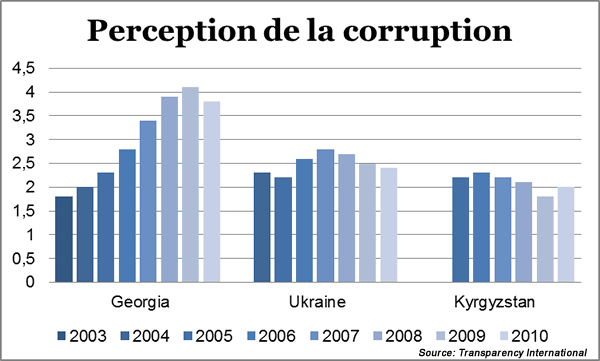
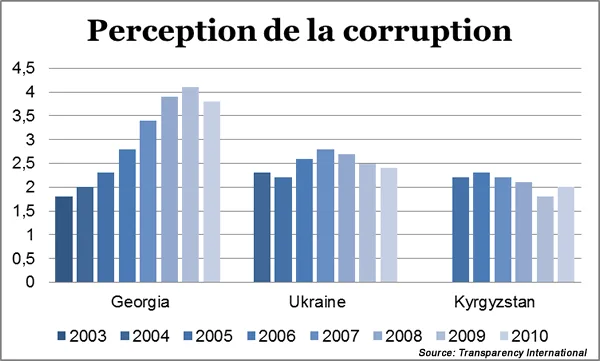
Since the revolution, Georgia has doubled is CPI, showing a significant improvement. The other two countries however are more disappointing: Since their respective revolutions, Ukraine’s score increased only by 4% whereas Kyrgyzstan decreased by 9%.
Overall the world has become less corrupt, thus diminishing the significance of the improvements in the Ukraine. Although the Ukraine is not the only country that has seen their score lowered; two dictator regimes who didn’t have a ‘color revolution’, Armenia and Turkmenistan, have respectively slid down 13% and 20% since 2003.
Press Freedom
The Press Freedom Index from Reporters Without Borders functions inversely to the CPI; a higher score indicates the country does not respect freedom of the press.
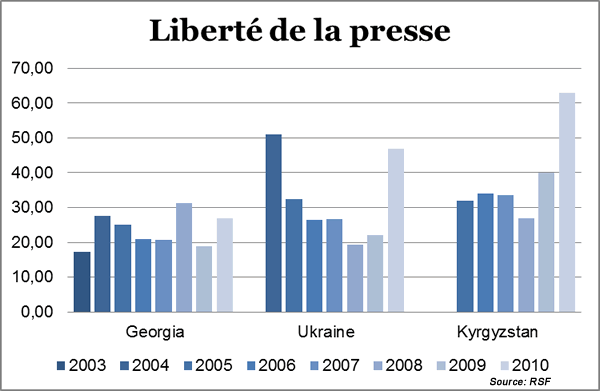
According to Reporters Without Borders, only journalists in the Ukraine benefited from a more liberal stance on freedom of expression right after the revolution. In general, the situation only deteriorated in Kyrgyzstan and plateaued in Georgia.
Political Stability and Absence of Violence
The World Bank ranks global governance through its aggregation of Worldwide Governance Indicators. The scores for our target countries are between -2.5 and +2.5, with a higher number signifying “better” governance (Read: closer to Western values).
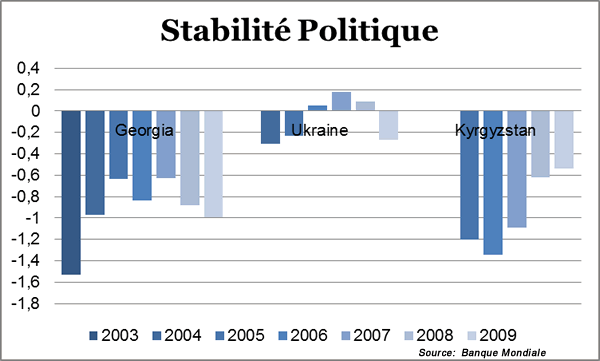
The indicators progress positively for all the countries concerned, with the Ukraine showing a 13% increase and a 55% increase for Kyrgyzstan. This shift is more significant than other countries in the region, like Armenia or Azerbaijan, which did not have similar revolutions.
Rule of Law
These statistics published by the World Bank reveal that only the Georgians have seen their legal system ameliorated after the revolution, with an improved court system and enforced property rights.
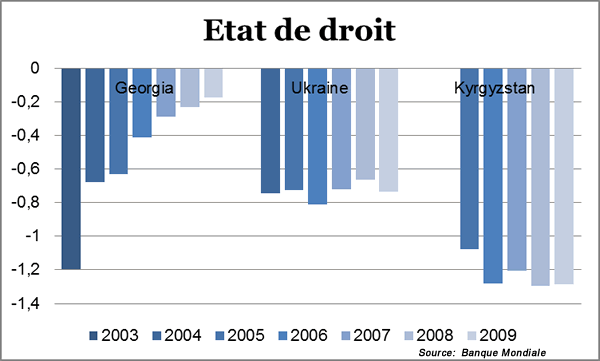
It could be better…
The data shows that national situations have not been dramatically impacted by the ’revolutions’ in the first decade of this century. In the Ukraine, Victor Yanukovich (dictator Leonid Kuchma’s candidate in 2004) has legally returned to power after 5 years of conflict between him and the different actors of the revolution.
In Georgia, Mikhail Saakachvili came to power in 2003 after overthrowing the dictator, and since then he has lost his reputation of being the country’s hope for democracy. His increased authoritarian tendencies corresponded to the occurrence of the 2008 South Ossetia war.
In Kyrgyzstan, the revolution never led to Democracy. During the months that followed, killings and riots damaged the country’s political life. The massacres in 2010 demolished the dream of stability and democracy for Kyrgyzstan.
Yet some positive aspects did arise from the revolutions. Certain measures implemented during the aftermath of the revolutions are still intact. For example, EU citizens can travel to both the Ukraine and Georgia without a visa. The Ukrainian parliament also passed a law recognizing the famine of 1932-33 (between 4 and 5 million dead) as a symbolic gesture to mark its independence from Moscow.
The silent revolution
Despite certain positive changes, it is evident that the only recent revolution that truly led to a democratic transition was the 1991 breakdown of the Soviet Union. Elsewhere, democratic institutions are gradually built over time and slowly releases itself from dictatorial power. In South Korea and in Mexico, the violent uprisings did not trigger significant political changes, even if the riots were an indicator unifying democratic undercurrents.
In light of these examples, one can imagine that the events in Tunisia and Egypt will not directly lead to Jeffersonian democracies. Yet we can celebrate the immediate fall of a dictators, and hope that the revolutions will brings the countries a small step towards a truly free society.
—
Photo Credits: alex_e14
💬 Discussion
No comments yet. Be the first to comment!