
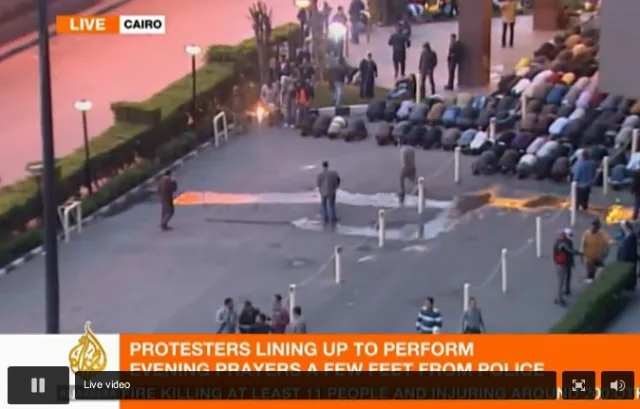
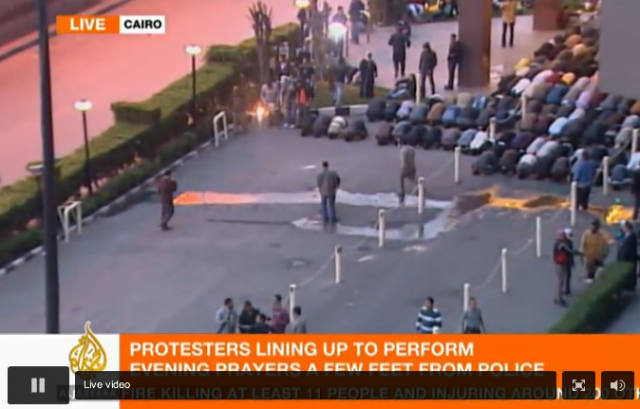
Since Egypt cut off its country’s Internet access on January 28, the world has been glued to the television. In response to King Abdullah of Saudi Arabia proclaiming his support for Mubarak and the subsequent changes in coverage from the Saudi channel Alldullah, millions of pairs of eyes have turned to Al-Jazeera English for information. A succession of images have replayed; we’ve seen protesters stop their advances to perform Friday prayers a few meters from the police, we saw the tanks rolling into Cairo, we heard the security forces pounding on studio’s door to cut Cairo’s broadcasting.
As the baby boomer generation will attest, television permits viewers to experience history in the making, such as the broadcasting of Neil Armstrong’s first steps on the moon in 1969. The coverage from Al-Jazeera English revives this sentiment we believed was reserved especially for small black and white tv screens. In a professional ecosystem where there is competition in being exclusive and first during major scoops, the Arabic news channel decided to share its imagines in the Creative Commons. Despite this, the news channel recorded an 2,500% increase in viewers.
The ongoing coverage has put the Egyptian government in an awkward situation. The Egyptian authorities have attempted to shut down the channel’s signal by confiscating their accreditation. According to some eyewitnesses, Al-Jazeera’s team has been threatened as a method of enforcing the Egyptian authority’s decision.
Friday, the police still loyal to Moubarak tried to secure access to the network’s headquarters, the same one where the president heckled at the demand for the government’s resignation. Today, it seems that this channel is stronger than the links that bind it to its octogenary president. Amid widespread blackout, Al-Jazeera has done the work of C-SPAN, which is the American parliamentary channel that continuously transmits the proceedings of the Senate and House of Representatives. It is not widely expressed, but C-SPAN (Cable Satellite for Public Affairs Network) is actually a great social achievement.
Replicated and distributed
Since the events in Iran during 2009, the idea of a revolution promoted through social networks has come a long way. After the uprising in Tunisia, many people wanted to to attribute the overthrow of Ben Ali to Facebook or Twitter. Even if Egyptians relied heavily on new media for their revolution, should we still rely on the phrase post hoc ergo propter hoc, “after this, therefore because of this?” Between those who believe that the revolution was driven by a faceless entity over the Internet and those who disagree, there are many arguments to consider. On Rue89, Pierre Haski made an analogy between the Arab revolts and the “Monday demonstrations” that preceded the fall of the Berlin Wall:
The fall of Ben Ali is like the fall of the Berlin Wall for the people of the Arab world. In many countries (Algeria, Jordan, Egypt, Yemen, etc.) the recording of the the desperate sacrifices in Sidi Bouzid and the demonstrations against the ruling regime had a huge psychologically impact. This was further amplified by the censorship of the Internet to prevent social networks from allowing the Tunisia revolution to repeat itself.
With the turn of the Egyptian revolt, it is easy to reminisce back to the 1970s of Gil-Scott Heron and his assertions against the mass media: “The Revolution Will Not Be Televised“. But beware of conventional wisdom: the revolution is not anymore driven by television today that it was in Cairo yesterday or tweeted in Tunis, Tehran, and Chisinau. Al-Jazeera is not “the” vehicle for a revolution which is replicated, distributed, disseminated, and faxed.
A downgraded form
If we look closer, Egypt’s situation is very different from Tunisia. After the immolation of Mohamed Bouazizi in Sidi Bouzid, networks served to give more depth than just television covering the surface of the issue. Yet after the events in Suez, Alexandria and Cairo, the television was useful in bypassing the incapacitated Internet connections.
What is remarkable is the Egyptians’ diversity and adaptation in using different methods to keep the revolution alive. IRC channels and EtherPads are available everywhere on the web, as anonymous users implemented these two complimentary strategies. Conversely they also distribute paper fliers, use Morse code, utilize amateur radio (HAM radio) and even fax memos to WikiLeaks to disseminate information on Egypt. As the common people are already the underdogs in the revolution, they can not afford to hide from censorship but must face the problem head-on. In the early hours of forming the revolution, it was critical to follow a type of neo-Luddite approach:
“Do not rely solely on online communications.”
Yet it would be inaccurate to suggest the Internet in general is not a useful tool. These anonymous users have also provided Egyptians with means to circumvent a short-circuited Internet. Tor, Proxy servers, VNP, and Remote Installation Services rend it possible to escape web surveillance. Several other initiatives such as We Rebuild (an aggregator of circumvention methods) and FDN (a French ISP Data Network) can connect Egyptians to these higher networks from their landlines. In other words, protesters are organizing resistance and guerrilla warfare using 56K modems. This use of technology seems to be a step backwards, yet it enforces the true sentiment of this type of revolution: “do it any way you can, and do it yourself.”
The emergence of this ‘downgraded’ form of the Internet suggests a “steampunk” type of revolution that is capable of regressing to a better-suited type of combat. Similar to a cockroach in the middle of a nuclear winter, the Internet is an indestructible force. What is happening now neither a Twitter revolution nor a television revolution. It’s an information revolution, and so far it’s in its highest form.
__
Photo Credits: Flickr CC modenadude, screenshot from Al-Jazeera.
💬 Discussion
No comments yet. Be the first to comment!