
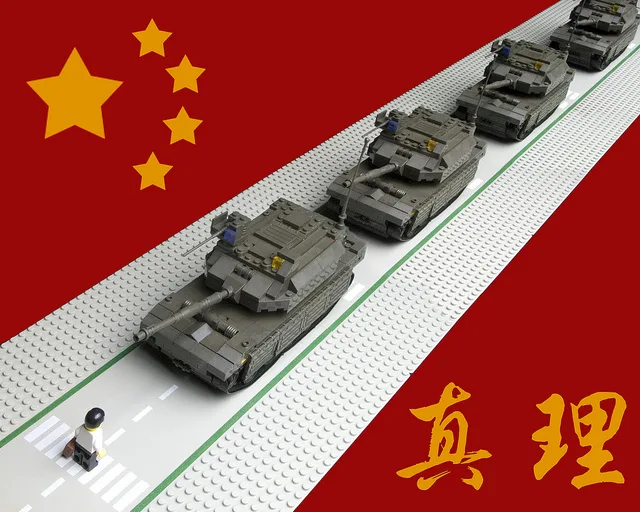
By the end of the year the US State department will spend $70 million on stealth communications technologies to enable activists to communicate beyond the reach of dictators according to a recent NYT article. Prototypes include a suitcase capable of quickly blanketing a region with a free wifi network, bluetooth devices that can silently share data, software that protects the anonymity of Chinese users, independent cellphone networks in Afghanistan, and underground buried cell phones on the border of North Korea for desperate phone calls to “freedom.” These are political tools deployed to promote the agenda of one nation over that of another. How should we address information imperialism? The use of networked communications tools to subvert so-called regimes exposes a proclivity for digital intervention that likely also includes digital literacy projects to provoke revolutionary actions, propaganda campaigns to make celebrities out of bloggers, and covert code warfare. Let’s review the spectrum of information interventions to ascertain the ways and hows of information imperialism.

Digital Literacy and Revolution
In 2007 my colleague Ramesh Srinivasan and I ethnographically documented the role of the US State department and US based philanthropic organizations in promoting digital literacy projects such as pro-revolutionary blogging in Kyrgyzstan. This digital literacy campaign translated into a culture of communication practice that helped a state-wide revolution, the 2005 Tulip Revolution. Much polemic debate circulates on the role of social media in the Arab Spring uprising. I don’t care to contribute to that debate here without the empirical data now being collected by Srinivasan in Cairo but in light of the evidence of US information intervention I am curious about the impact of US backed operations of digital literacy in Tunisia, Syria, and Egypt. Certainly the grassroots activists putting their bodies on the line are more important than the Silicon Valley entrepreneurs or State Department moles but the role of US-promoted information intermediaries should concern anthropologists and activists worried about the incarnation of imperialism in the infomatic public sphere.
Cyber-Celebrities
What else is the US State department doing to promote the use of the internet to promote its agenda worldwide? I’ve just returned from Netroots Nation 2011, the signature event of internet activism. This year’s speakers included internet fundraising pioneer Howard Dean and net neutrality advocate Sen. Al Franken. I attended a panel The Arab Spring: A Case Study for New Media as a Catalyst for Change, which features Bahraini, Iraqi, Palestinian, and Moroccan bloggers. Their stories were riveting and polished and left me wondering how they could afford to travel to the United States. I have a suspicion that they have been funded by the State Department to do a multi-city tour telling their stories of pro-democracy digital activism. Might “freedom loving” institutions have something to gain by making celebrities of these Middle Eastern bloggers? I am not so paranoid to think that the nomenclature surrounding the promotion of the “Twitter Revolution” was actually a way to textually lay claim to the Arab Spring for Silicon Valley companies, but I do think that states realize the power of evocative branding operations to win hearts and minds. These blogger’s national tour may be an example.
Code as Weapon
Think about Stuxnet, the first publicized computer virus weapon, which burrowed into the Iranian nuclear and oil power systems and awaited command to send Iran into a nation-wide blackout or worse create a nuclear meltdown. Nobody knows where Stuxnet came from but Israel and the US are the primary subjects in the gossip. Dimona is the center of Israel’s “secret” nuclear facility and according to a NYT article is the location of the testing of the efficacy of the Stuxnet virus. It is undoubtable that national security and imperial aspirations are driving the development of Stuxnet 2.0. And now after its discovery Stuxnet has been liberated from nationalistic secrecy by becoming open-source. If you are interested in creating global chaos you can download and work on it from links here. As this video graphically details hackers are playing with and retooling it now. This should alarm anyone into peace and national or ethnic autonomy.
Information Imperialism?
The ideological component of information imperialism can be gleamed from Secretary of State Hillary Clinton’s rousing speech earlier this year where she calls out Tunisia, Uzbekistan, Egypt, Iran, Saudi Arabia and Vietnam for “a spike in threats to the free flow of information.” The financing of these covert mesh networks and the publicizing of pro-freedom speeches is part of a US strategy of opening-up countries to communication from which it is hoped democracy and possibly other freedoms such as global entrepreneurialism will follow. Against Clinton’s remarks, Chinese Foreign Ministry spokesman Ma Zhaoxu defended China’s policies. A Chinese state-run newspaper labeled Clinton’s words as “information imperialism.” It seems to me that the rhetoric and practice of information imperialism is ripe for anthropological curiosity.

As these cases point out, national institutions deploy a bevy of rhetorical and technical practices to promote their agendas. $70 million is a small sum when compared to other State Department activities and doesn’t even pay for a toilet seat in the Pentagon but it does represent a very public intervention in the autonomy of other nations. Now, with the internet in a suitcase, cosmopolitan revolutionary cyber-celebrities, and Stuxnet-like code weapons information imperialism is well-beyond the vaguely inspirational and threatening pontifications of a seasoned bureaucrat.
Where do we as scholars and activists stand on these issues? In what ways is the project of affirming national or ethnic sovereignty complicated by the euphoria about new media and its role in promoting decentralized and agenda-afforded communications networks that can promote democracy? Is the development and use of pro-communications technologies an act of imperialistic info-warfare or a savvy form of legitimate democratic promotion? Is there a difference? How can anthropology address these important issues?
—
This post was originally published on SavageMinds
Photo Credits: Flickr CC Eric Constantineau – www.ericconstantineau.com
💬 Discussion
No comments yet. Be the first to comment!