
![[ebook] Rugby Stories: The inside scoop behind the sport](https://owni.eu/uploads/owni/couv.rugby_.english-723x1024-8bcaa698.webp)
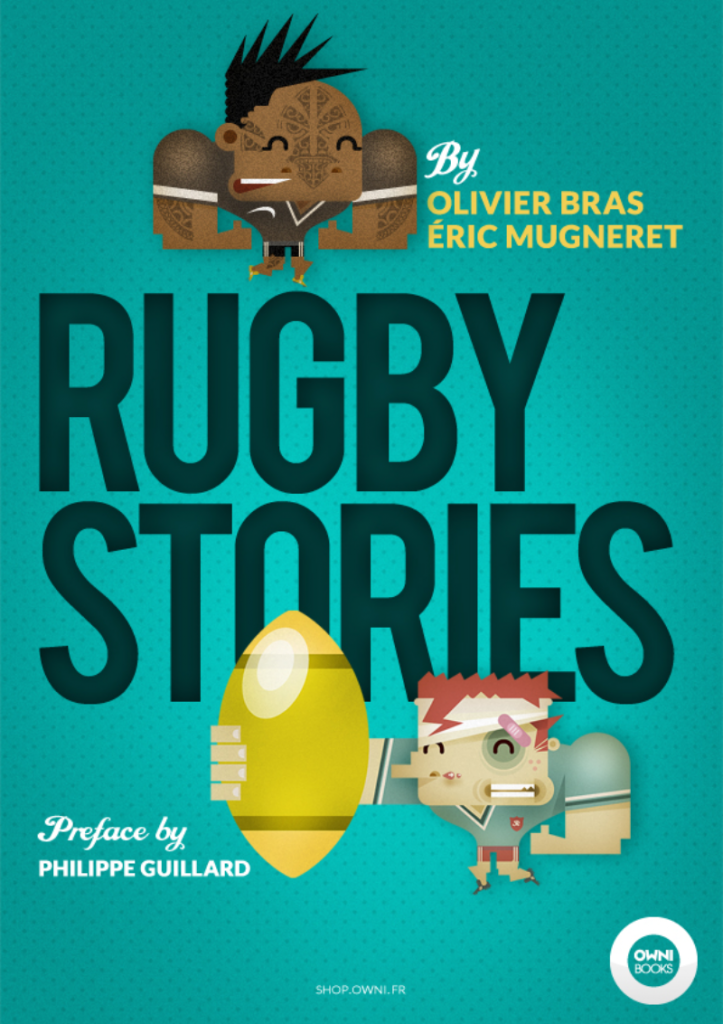
Rugby Stories: A new ebook by OWNI
Rugby fever is in the air for fans throughout the world. This year, the seventh Rugby World Cup will be played on the All Blacks’ turf in New Zealand. Olivier Bras and Eric Mugneret reveal the inside scoop and best tales of the “hooligans’ game played by gentlemen.”
Go behind the scenes to meet the men who shaped this legendary sport. Learn about indispensable players such as “The Bull,” “Super Mario,” and “The Carpathian Bus.” Relive the greatest achievements of the giant Jonah Lomu, and other warriors from New Zealand – renowned for scoring 1711 during 36 World Cup matches. Once again, the old world will have to play with determination to shake the pack from South Africa.
The event of the season is beginning to reach a boiling point – feel the heat with Rugby Stories!
Find our ebook Rugby Stories on our online store!
C is for … CHRONO
Ten seconds and fifty fiftieths! This is the time set for 100 metres by the American rugby player Takudzwa Ngwenya when he was still a student in the USA. This player, originally from Zimbabwe, stole the limelight during the 2007 World Cup, by scoring a sumptuous try against South Africa once he had managed to get away from the wing Bryan Habana. The latter, however, is attributed with even more unbelievable statistics because he has a personal record of 10.40 seconds for 100 metres.
These are two wingers with exceptional speed who can’t, in spite of it all, overtake Tonderai Chavhanga. This player from the Stormers, selected for the Springboks four times, achieved a time of 10.27 for 100 metres. This performance would have placed him sixth in the 100 metre finals in the last European Athletic Championships (2010). Jonah Lomu was credited with a time of 10.8 at the peak of his career.
F is for … FULL HOUSE
What the Brits call a full house, the French call a “carton plein.” This feat consists in a player scoring points in all the ways you can in the game of rugby. Score a try, pull off a conversion, score a penalty and drop a goal between the posts. It’s not as easy as it sounds… In all the time the World Cup has been around, only two French players have managed this royal flush. Christophe “Titou” Lamaison made the All Blacks sick in the World Cup semi final on 31 October 1999, in London. The fly half reeled in the points for the blue house: one try, three penalties, four conversions and two drop goals. Twenty-eight points on the meter.
Four years later, in Australia, another Frenchman managed this statistically rare performance. Frédéric Michalak, who has just turned 21, achieved a try, four conversions, two drop goals and four penalties against Scotland in a group match.
G is for … GUINNESS
A try can provide a big return! In 1999, Guinness, the famous brand of Irish beer sponsoring the event, promised 10,000 pounds sterling to the first player to score a try in less than 120 seconds. i.e. the time needed to serve a pint of Guinness properly. It was the Australian centre Tim Horan who was finally able to get his hands on the prize by scoring a try 90 seconds after the start of the match against Romania, in Belfast on October 3.
H is for … HEART
On 25 July 2006, the Canadian prop Jon Thiel was in the hands of a surgeon who was replacing a heart valve with a biological prosthesis. The doctors who had just discovered that he had a congenital heart disease did not know at that time the effect this could have on the 31 year-old player. On 9 September 2007, he was on the Canada team for the kickoff in the first World Cup match against Wales in Nantes. Jon Thiel played his team’s four games in this competition. He completed the 2009 – 2010 season with RC Chalon, in Fédérale 1, the highest level of French amateur rugby.
J is for … JONES
During its twenty-five World Cup matches, Wales has always had a Jones on the team, on the field, for the kick-off or, of course, on the substitute bench. This common Welsh surname has become the enemy of sports commentators who can easily get first names confused. And not without reason! In 2007, the Welsh played two matches with five of the twenty-five players on the match list with the surname Jones. Other surnames repeat over the generations in the history of Welsh rugby, names like Davies, Evans, Thomas and Phillips and so on.
K is for … KILOS
The first six World Cups saw some lovely babies on the scales. Even if it isn’t easy to know the exact weight of all the participants, some of them have left an enduring mark. With his 143 kilos, the Welsh second row Craig Quinnell is considered to be the heaviest player of all the cups. He is closely followed by the Namibian prop Marius Visser (142 kilos). Scott Quinnell, Craig’s older brother, played well as a centre flanker with his 132 kilos. The island selections such as Samoa, are not at the bottom of the barrel, either with their player Henry Tuilagi, who could get through anywhere with his 128 kilos. The Fijians however have never played their heaviest player, prop Viliame Cavubati, weighing in at 158 kilos, in a World Cup. He was selected 28 times for Fiji and played for about 15 minutes against Les Bleus in 1998, during a match in Suva.
M is for… MYTH
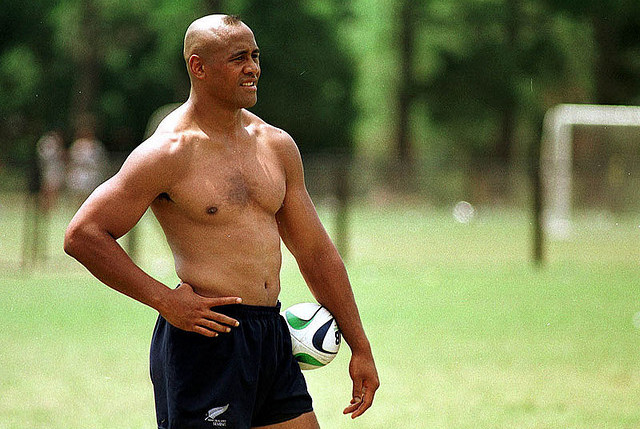
A UFO landed on planet rugby in 1995. Jonah Lomu, who was 20 at the time, caused his opponents to break out in a cold sweat. Not the typical build for a winger (1.94 m, 118 kg), Lomu was the attraction of the World Cup. New Zealand played England on 18 June 1995, in Cape Town. After 10 minutes of play, Lomu scored a try from nowhere. The winger caught a badly-estimated skip pass in the opponent’s 40m. Lomu launched into action, fought off his counterpart Tony Underwood, who is 47 kg and 27 cm smaller than him, topples Will Carling and flattens Mike Catt in his dash to the try. The Lomu myth was born. He scored four tries against England during this match. Before the final against South Africa, the specialists were getting excited: how can we stop Lomu? The South African branch of Shell even offered to donate 5,000 rand for the development of South African rugby each time the Boks stopped Lomu the bus, before deciding otherwise in light of the protests made by the New Zealand managers. Lomu did not score in the final.
Parlez-vous français? Check out the French version of this ebook!

Photo Source: FlickR CC fabian gastiarena
💬 Discussion
No comments yet. Be the first to comment!