
![[Interactive Map] Chinese investments in Europe](https://owni.eu/uploads/owni/courbe-ide-europe-7e2d1af4.webp)
The interactive app above allows you to explore the significant Chinese investments in Europe.
Châteauroux, the calm capital of the Indre region in France, has surrounding fields, an old military base, “berrichon pie” – and will soon be the home of a new business district. Currently the army is moving out of some old 1950’s American military facilities, and the Chinese are preparing to take over the area with hundreds of millions of euros in their pockets. Beijing is heading to Berry [FR] to occupy its first European military base. Starting in 2012, a new industrial park (consisting of roughly 850 hectares) will host 40 Chinese companies specializing in high technology and renewable energy – bringing the promise of adding 3,200 jobs to the local economy.
Europe is struggling to stay above the waterline through buying bonds, acquiring companies on the verge of failure, and engaging in a currency war … Right now, China and its mountains of bills are very impressive – even alarming. After massively investing in Africa, China is turning towards the high-value sectors in the old world – with the goal to be intertwined with emerging and growing industries.
These Chinese investments need to be put into prospective. During 2009, they accounted for only 0.4% of total stock in the Foreign Direct Investments in the European Union.
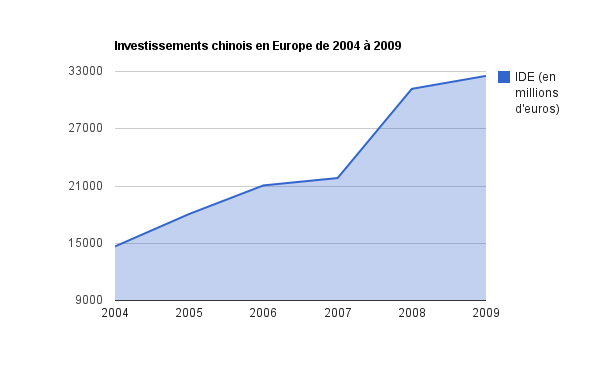
Chinese investments in Europe between 2004 and 2009
Yet their rhythm of growth is astonishing. While relatively stable until 2004, Chinese investments multiplied by a factor of 13 over a span of six years. While no data after 2009 is available, it’s safe to say that growth has accelerated. During the first six months of 2011, the Chinese acquisitions of companies in Western Europe were five times higher than the combined total for 2010.
Measuring the implications of China’s presence in Europe is challenging. It’s difficult not to get tangled-up in a financial web, as when it comes to hard numbers opacity seems to be the theme – no strong database exists on the subject. To create the above app, OWNI’s calculations were based on Chinese FDI stocks (Hong-Kong included) in the European Union, along with a non-exhaustive review of major acquisitions by Chinese economic actors in recent years (up to August 2011). While Hong Kong is a unique case, it’s included in the app because the majority of Chinese capital passes through this metropolitan hub.
This does not include purchasing European public debt, a subject that recently made headlines. If China published its total cash reserved, it’s certain the results would comprise of detailed secrets. Yet it’s impossible to know exactly what form of treasures have been acquired, and how much. On the conditions of anonymity, a department of the European Central Bank recently estimated loans from China to countries in southern Europe are in the range of 15 to 20 billion euros (“peanuts,” according to the authority). If these figures are confirmed, it will prove to be considerably weaker than initially forecasted.
Moving towards technology
Following a logical move within economic history, China is moving from an economy based on producing cheap goods to a service economy based on industries with high added-value. Unlike Africa, the Old World doesn’t really have attractive reserves of natural resources that can fuel the phenomenally high energy needs in China – however it does possess very intriguing high-tech industries.
It’s not a coincidence that investments in Europe took-off in 2005, as this is the year that marks the beginning of China’s new long-term strategy. Foreign investments in strategic sectors is strongly encouraged, even supported, through public funds and tax benefits. The five-year plan gives guidance on investments. The 11th five-year plan (2005-2010) defined for the first time which sectors to target: biotechnology, state-of-the-art equipment, and information technology. The 12th five-year plan (2010-2015), implemented in March, outlines the area of future Chinese investments: green technology, alternative energy, and clean vehicles.
As shown in the chart above, the distribution of Chinese investments in Europe reflects the main strategic priorities – both for the the present and future. Investment in the mining industry is the only element which seems confusing. This disproportion can be explained by the expensive acquisition of holdings, and control of large groups based in Britain (Rio Tinto, Caledon Resources, etc.) for accessing the Common Wealth’s mineral resources.
Private and Public investors
A good proportion of China’s capital comes from a few select giant conglomerates (notably in Hong King), which reflect the image of Cheung Kong, owned by billionaire Li Ka Shing. The company has grown over the decades – from being plastic manufactures in the 1950s to becoming a multinational corporation, indicating a wide-range of ramifications. Through its subsidiaries, Cheung Kong Infrastructures Holdings Ltd alone has invested close to twelve billion in European energy companies.
Other major players in China’s Europe include public groups from China’s mainland. While the names China Development Bank, China Investment Corporation, and CITIC may not be familiar to Western ears, they are the backbone of China’s strategy. Whether it’s becoming a major shareholder in Barclays or investing to the tune of seven billion euros in Europe’s production of solar panels, clearly they have a hand in all strategic sectors.
China’s role may not stop there, as the intentions and structures of certain “private” companies are called into question. In 2005, the telecom giant Huawei attempted to buy the telephone company Marconi. Rumors also suggest that there are close ties between the conglomerate and the Chinese National Army (as the founder of Huawei was formerly in the military). In 2009, the United States prohibited the group from taking full control of communications networks on their territory. Meanwhile, Italy has welcomed Huawei’s plans to build a national telecom network with open arms.
Faced with China’s growing presence, European countries are (once again) divided and incapable of deciding a defined course of action. At a time when Confucian institutions are proliferating [FR] and a growing number a students are looking at experiencing education in the Far East, China is enhancing its economic control through soft power. Whatever the final objectives, China may have the last word. A senior Chinese official recently summarized the situation in these stark terms:
You need our money.
__
Application created by Marion Boucharlat (design), Valentin Squirelo (development) and Guénaël Pépin (data processing).
Illustrations: FlickR CC 

 Gwenaël Piaser / Mathias M / Diogo Martins.
💬 Discussion
No comments yet. Be the first to comment!