
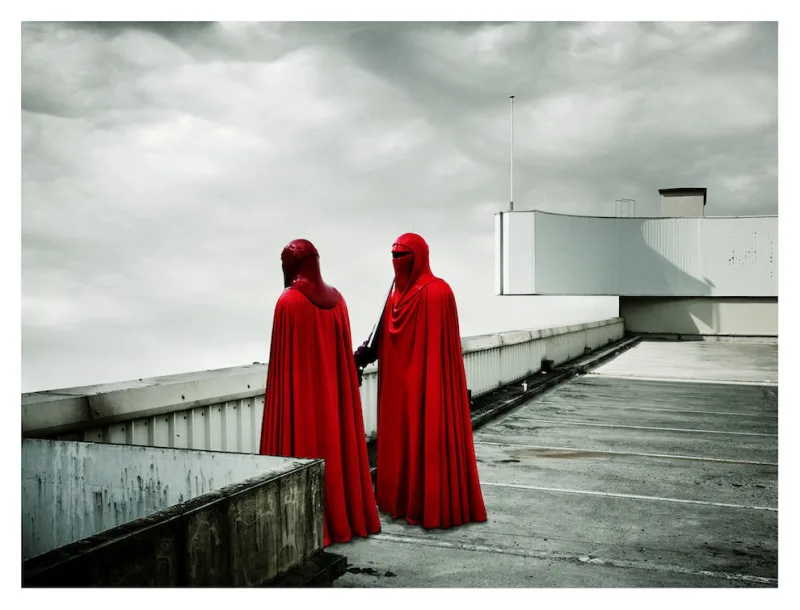
Thirty years after the release of George Lucas’ Star Wars trilogy, his characters appear to have found their place in our world as seen through the eyes of Cédric Delsaux. At once familiar and foreign, Dark Lens is a strange, pessimistic series of images imbued with a sense of melancholy and loneliness. It offers a different perspective on our everyday world, out on the margins, somewhere between reality and fiction. Delsaux began the Dark Lens series in 2004 in the suburbs of Paris and around the French city of Lille, before a detour through Ukraine, Iceland and the megalopolises of Sao Paulo and Dubai.
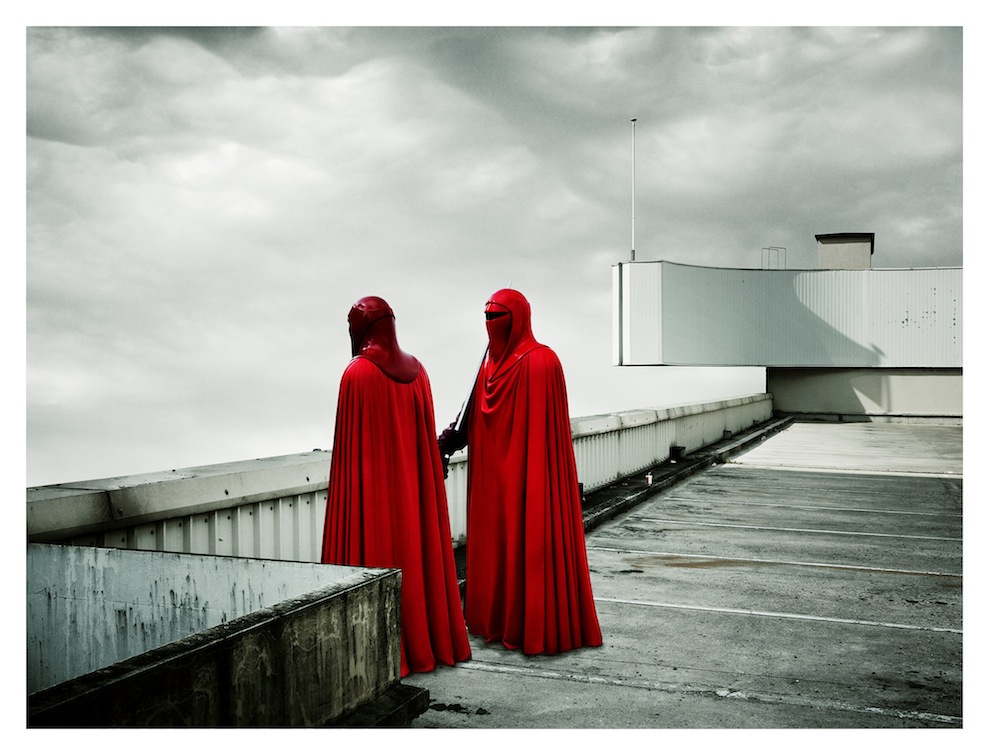
Imperial Guards - Dark Lens - © Cédric Delsaux
What gave you the idea for the Dark Lens series?
What led me to do the photos wasn’t Star Wars itself, but workplaces. They may seem trivial and dull but to me they often seem crazy and surreal. To me reality can be fantastical and so I took that idea literally by including fantastical characters. I started with this photo of the A4 motorway to the north of Paris without any of the characters.
There was something crazy about it to me, it looked like a spaceship. I felt like it spoke of a world light years away and all it was missing was a little something for it to take off and go further. All we had to do was add this extra element, these Star Wars figurines.
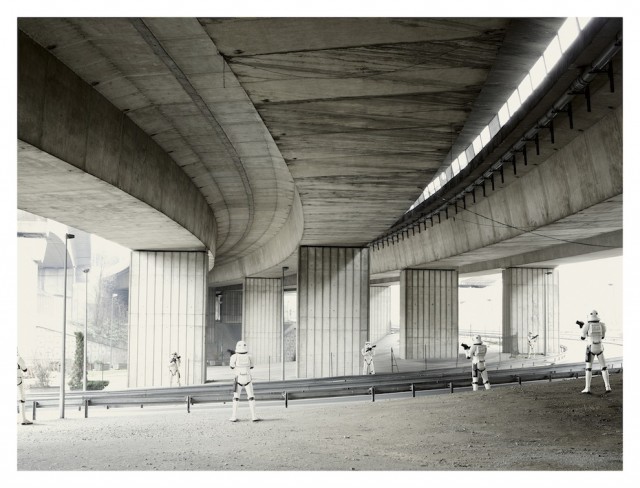
Dark Lens ©Cedric Delsaux
What order do you work in? Do you already have the scene with the characters in your head or do you need to see the landscape first?
First of all I get an intuition of a place and when I arrive I often say to myself, “this is it.” At a location I can take a lot of photos, because it speaks to me, and it’s more interesting to me if I haven’t thought about it before. Otherwise it can almost feel like I’m repeating myself. Once I have the location, I have in mind what character I want to insert. So I have the foundation to fill in, I just have to find the characters and enough technical quality that the retouching will work without looking like a bad joke. The idea wasn’t to joke about with the series, even if some of the montages are funny. I’m not a real collector or anything, so I borrowed the figurines from a shop in Paris that helped me out.
![Bobba Fett [Dark Lens - ©Cédric Delsaux]](/uploads/owni/bobba-fett-paris-cedricdelsaux-darklens-e1320318026894-c38dc025.jpg "bobba-fett-paris-cedricdelsaux-darklens")
Bobba Fett - Dark Lens ©Cédric Delsaux
Initially I wanted to take the photos in the street but it was too complicated. I was even stopped once in a shopping center (for the photo of Bobba Fett) by the security guy who mistook me for some crazy geek. In the studio it’s much simpler to get the right light, and then I can crop the character and integrate it into the image. The more realistic it is the more interesting it is, even with imperfections.
The Dark Lens series took place over the course of five years, but in reality I work ten days on location and then I spend time working the characters into the images in the studio, which can take quite a long time.

The crash - Dubai - © Cédric Delsaux
There’s another link in the series with the Star Wars trilogy, where sites like the Death Star are constantly being built or getting destroyed.
It’s a fair point, I didn’t make that connection. I guess that’s another thing that drew me to the trilogy and made me think I should use it in my work. The same fascination with construction and destruction exists (in the series). If we had an ordinary ship that was all white chrome, we’d think it’s ridiculous, that it’s not possible. It works because Lucas also includes an aesthetic of ruin, decay, wear and entropy even in the depths of science fiction. And that makes the characters inserted in our world seem realistic and believable.
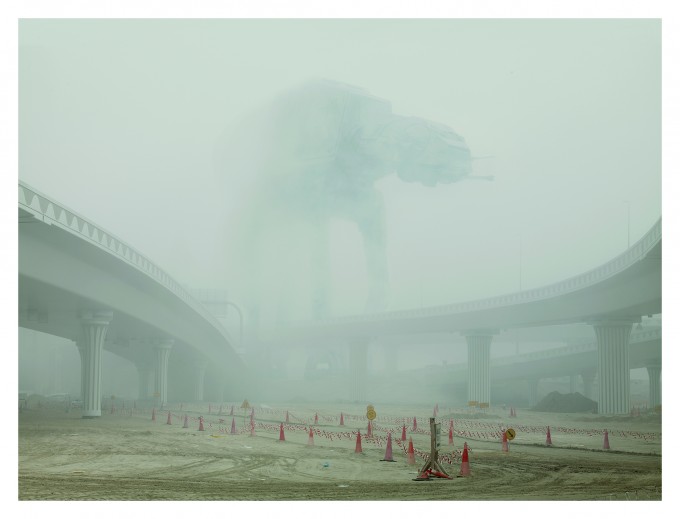
Dark Lens - © Cédric Delsaux
The series leaves an impression of melancholy and isolation. How do you scout out the locations, and how do you work out the staging and framing of the images?
Initially I do this alone. I dream up this reality by superimposing different cinematic images. At heart, this is the message I’m trying to get across: we don’t evolve in the real world, but in the idea of it that we create, in the fantasy that covers it. It’s unconscious, we feel like it’s objective, but our perception is highly subjective. The format comes from this origin, and the frames are constructed in much the same way. It works, I assume, much like a painter who raises his easel and presents a space that seems static, as if nothing came from the outside.
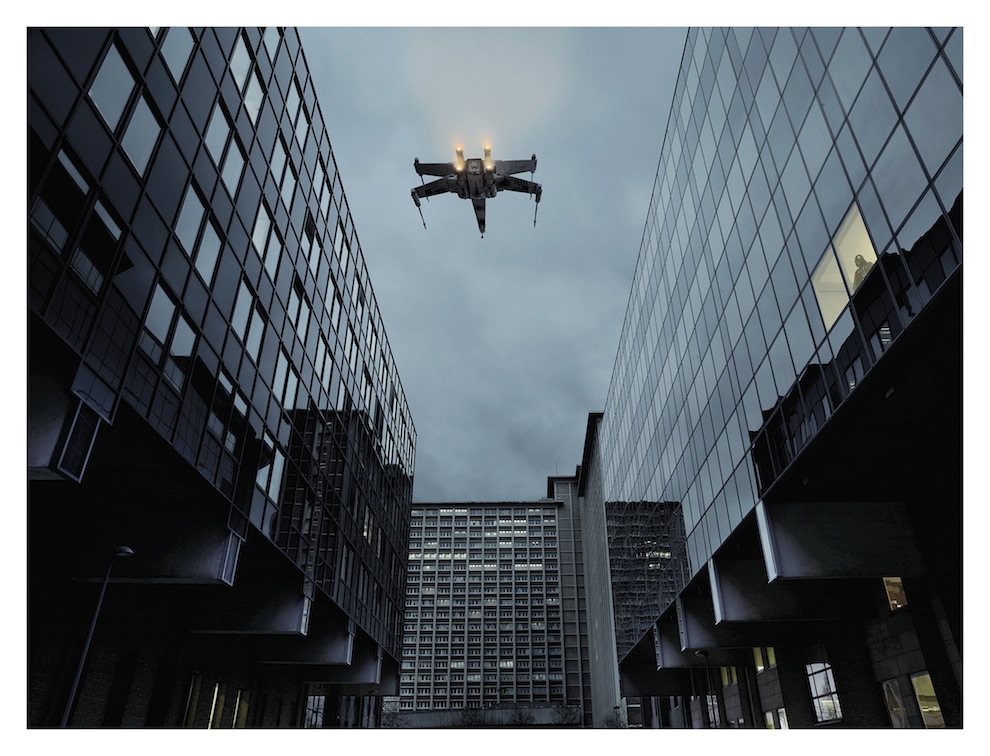
Dark Lens - © Cédric Delsaux
I come from the large camera format, so I was able to photograph the series that way. But it’s heavy and expensive so I switched to digital. I used a heavy camera stand, I didn’t do the pictures handheld, hence the impression of a dotted frame. I have fixed them up a bit for the book, for this simple reason, against my will. I started the series with a different digital image sensor – a Canon 24×36 – and then a medium format camera with a digital back and a different shutter speed.
I’m looking for an image that’s as clear as possible. From the slightly chaotic and complicated reality, I cut and crop to simplify it, make it readable. Each photo must be a mystery but also as clear as possible. I like this relationship between the two elements, between these science-fiction characters and reality.
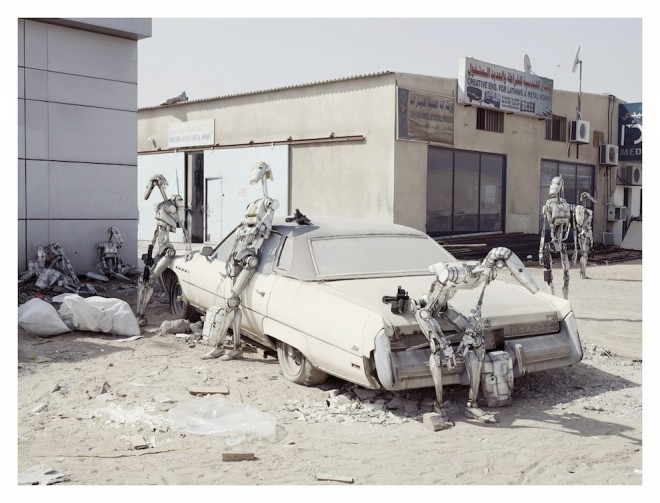 Technically, how do you insert the characters?

The real difficulty is to find a sufficiently empty place from which a certain poetry emanates. The images aren’t all built the same way. Some are a simple: a character juxtaposed with a place. The more I advanced with the work, the more I found it interesting to seek out places that would not be out of place in science fiction, where the characters would blend in completely. In some of the other photos, you almost have to go looking for the characters in the image.
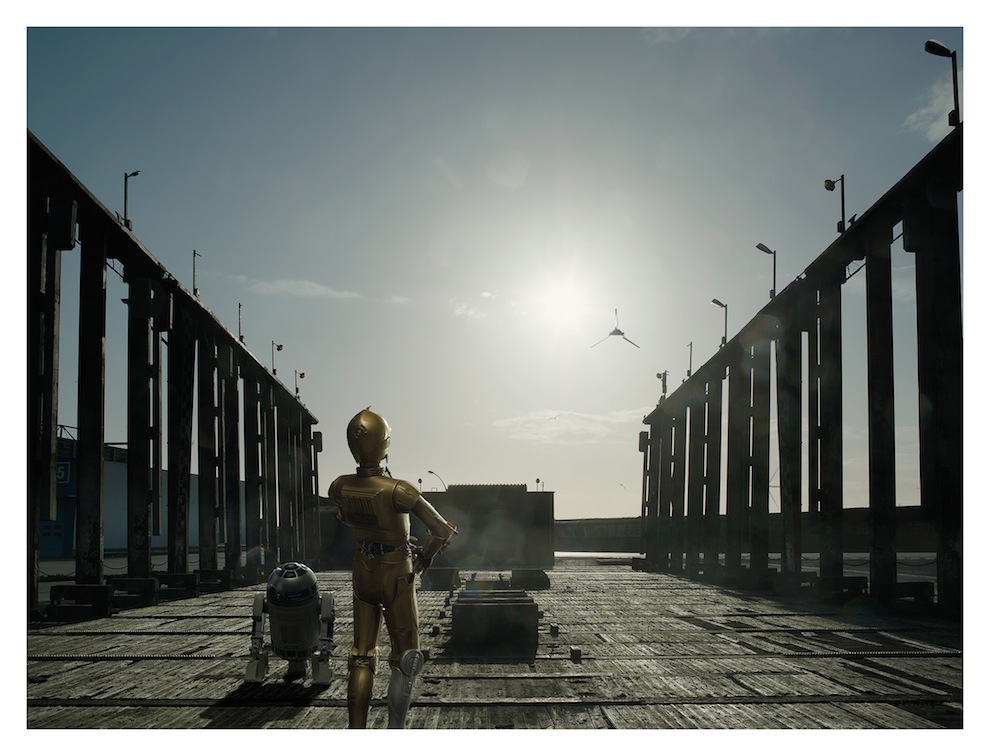
R2D2 and C3PO - Lille - Dark Lens - © Cédric Delsaux
One of the characters, the battle droid was made in 3D by Pierrick Guenneugues. I wanted to use them but they’re not prominent figures in the film series so I couldn’t find any nice figurines of them. With the 3D model I could get all the possible movements, and they humanizes the characters a little. I only used two real characters, people in costumes because the figurine couldn’t render the texture of the clothes.
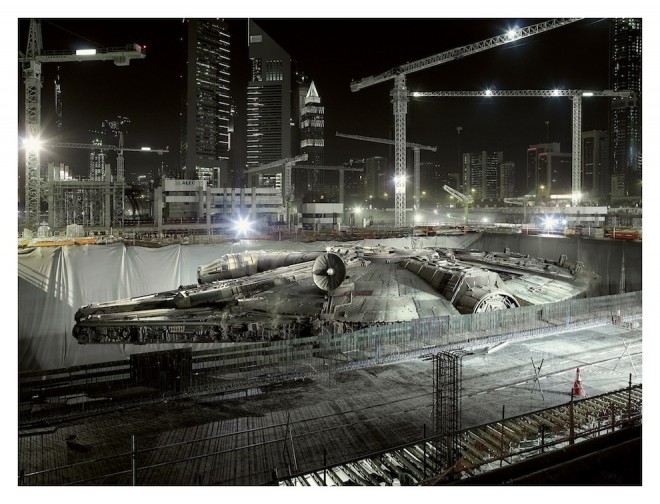
The Millenium Falcon - Dark Lens - © Cédric Delsaux
Photographs: Cédric Delsaux, all rights reserved.
The book DARK LENS by Cédric Delsaux is published by Éditions Xavier Barral
Exhibition at MK2 Bibliothèque, Paris starts November 24.
💬 Discussion
No comments yet. Be the first to comment!