
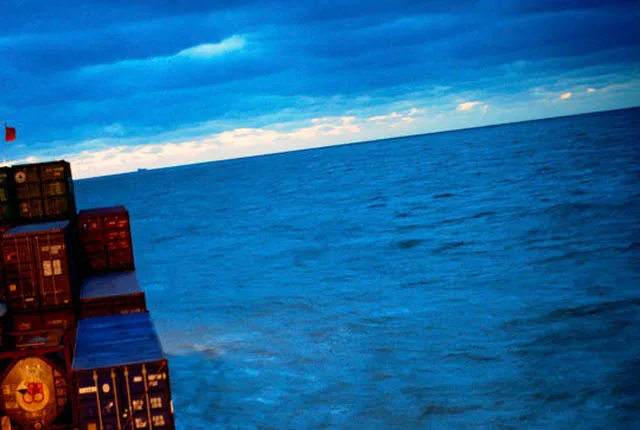
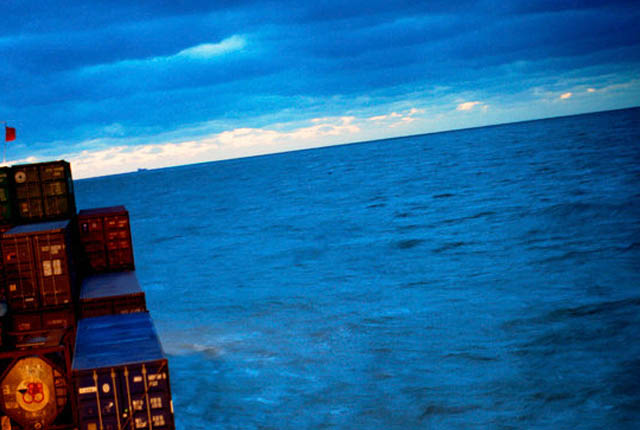
© Laurent Vautrin, Le Carton/Picturetank
France is preparing to import nearly 180 kg of weapons grade uranium from the United States by transporting it across the Atlantic Ocean on a ship that does not meet the required safety standards for such transportation. On October 21 of last year, a research centre in France, l’Institut Laue-Langevin, obtained a license from the US to receive the “weapons grade” uranium, via a subsidiary of energy multinational Areva, according to documents from the US Department of Energy (available at the bottom of this article).
Bon voyage
According to information obtained by OWNI, the uranium is about to leave US soil from a port (the name of which we won’t disclose for security reasons), aboard a British ship owned by the Nuclear Decommissioning Authority (the NDA – of which TN International, a fuel transportation subsidiary of Areva, is a shareholder).
It will carry in its hold a little less than 180 kilograms of 93% enriched uranium, destined for the premises of the atomic energy company CERCA near Valence, in eastern France, for aluminum assembly. From there the uranium will fuel the HFR (high flux reactor) research reactor at the Institut Laue-Langevin in Grenoble, an institution which is owned in part by the Atomic Energy Commission (CEA) and the French National Centre for Scientific Research (CNRS).
On March 16, the US Nuclear Regulatory Commission granted final authorisation for the proposed transportation (page 7 of the document below). But the NDA ship chartered for the voyage is 25 years old and no longer meets the required safety standards for transportation of this type – deemed high risk because of the weapons grade level of the uranium and the attention that it might arouse.
OWNI has been able to learn the name and logistics of the vessel, which belongs to a fleet that is soon to be destroyed. Other boats of its type and its generation are currently being replaced. A specialist is surprised.
These boats are designed for it, and those types of voyages happen from time to time, transporting MOX to Japan for example. Although 25 years old for a boat carrying out uranium transport, that’s old.
The fleet of British boats have faced problems related to corrosion of the hull, the main reason why I a decision was taken to overhaul the NDA boats. That decision came despite improvements made “to enhance operational flexibility by making it compatible with the greatest number of packages and ISO containers, in order to meet customer needs“. Yannick Rousselet, head of nuclear campaigning for Greenpeace puts it more simply.
The NDA originally wanted to build a new boat. In the end, for financial reasons, they decided not to build this boat, and have chosen to salvage this one. It’s puzzling that they would end up with an old boat for this transportation!
While it was being used for MOX deliveries to Japan, “it possessed defensive guns, which a statement says have since been removed,” says Rousselet. He also observed another anomaly, one confirmed by a map of the port from which the boat will embark. While ships carrying cargo of this type usually sail in groups, to protect themselves throughout the journey, the vessel hired by Areva was moored alone in the port.
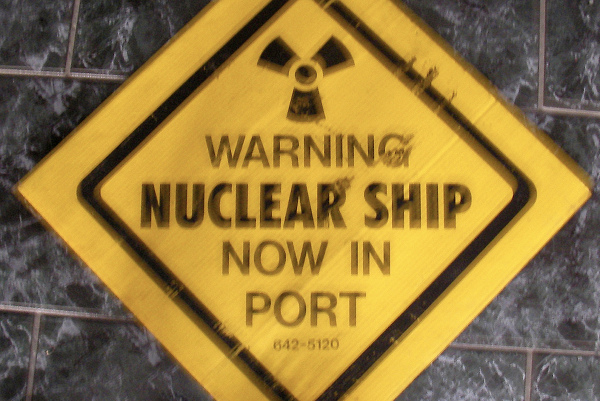
Loose lips sink ships?
For Yannick Rousselet:
There is clearly a problem with regard to the risk of proliferation. To have usable materials for military purposes like this, directly on the ocean…And it has the advantage of being in directly usable metallic form. One of the biggest risks is also the appropriation of nuclear materials.”
Faced with the security requirements of the convoy, nuclear lobbies have remained silent. If no one is aware of the convoy, the convoy is secure, QED. Yannick Rousselet quips:
Prove to me that we do not know this secret! Someone who really wants these materials can get to them.
Contacted in the course of our investigation, Julian Duperray, spokesman for the transportation activity of Areva, said that “certain activities are clearly classified and we cannot communicate on them. Transport of this type of material represents a small part of our activities.”
View the full document by clicking on the link.
Image Credits: Picture Tank by © Laurent Vautrin/Le Carton, all rights reserved. Steven and Darusha CC-BY-NC
Follow @CBerthelemy on Twitter
💬 Discussion
No comments yet. Be the first to comment!