
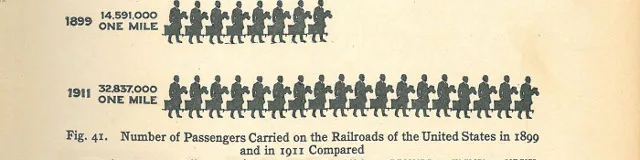
First up this week, a small article on informational design, which shows us – by looking at the 1917 book Graphic Methods for Presenting Facts – that our graphics today are far from revolutionary. Thanks to Karen for directing us towards this, for whom most of the graphic journalism links we suggest each week are already #oldinks.

DataWOW
As we put the finishing touches to the very special toy we’re building here at OWNI for the French presidential election, we couldn’t miss an opportunity to heap praise on two “big data” applications this week.
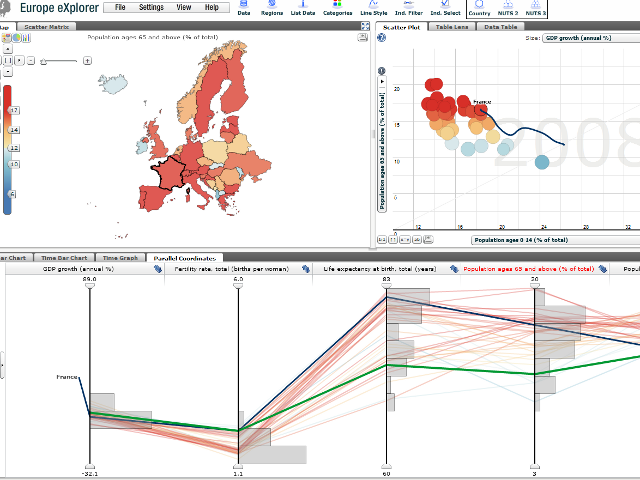
The eXplorer platforms of the Swedish company NComVA process very large volumes of data to create stunning statistical visualizations. Europe Explorer allows the user to navigate their way through a large (and downloadable) dataset containing economic and demographic information on European countries. The highlight – one can also customize the data displayed – such as GDP growth, fertility rate, life expectancy at birth or population by age.
Total Annual Building Energy Consumption for New York City is a formidable application created by the research group of Professor Viraj Modi, a specialist on energy sources and fluid mechanics at Columbia University. As its name suggests, this interactive application aims to provide an estimate of the energy consumption of each building in New York based on an ad hoc study and a fairly refined methodology. We gave ourselves a headache imagining the time it took to gather together and coordinate the data. A glimpse of a perfect “open data” world…
DataDuds
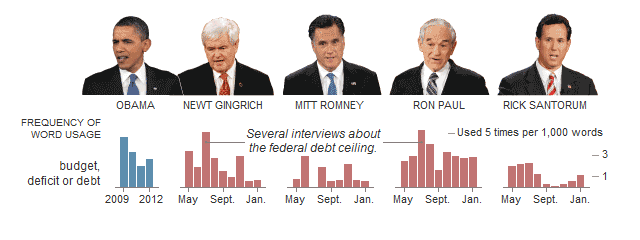
To accompany a (good) analysis of the State of the Union speech in the US, the NYT finally cracked and put together an infographic comparing the frequency of use of words by President Obama with those used by his putative Republican opponents. Using a histogram format in the context of a lexical analysis is pretty original – and not easy to pull off. However, two major pitfalls make this a rare disappointing NYT data experience. First, Obama is assessed on his four addresses to the nation (2009-2012) while the Republican candidates are assessed on the basis of “several interviews” from the past nine months. Second, the number of observed occurrences of a word exceeds seven just once. For the most part, they’re dealing with occurrences of between one and five, which makes the analysis biased given the size of the subject studied.
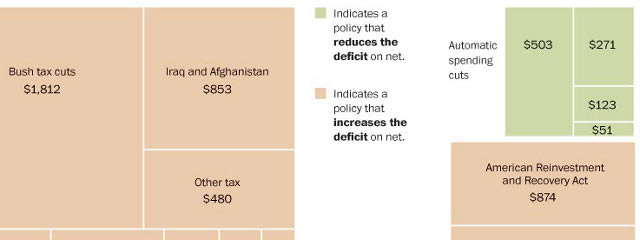
Our second “disappointment” of the week is this Washington Post treemap visualization. It accompanies a rather technical article (paywall) on economics that unpacks Obama’s “deficits” and compares them with those caused by Bush 2. The treemap format is still a powerful way to compare budgets (we’re reminded of this piece of brilliance by Jean Abbiateci) but we expect something more from the WashPo than a poorly compressed image, a bunch of variously sized cubes and projections well into 2017 about the cost of Obama’a policies.
DataCoq
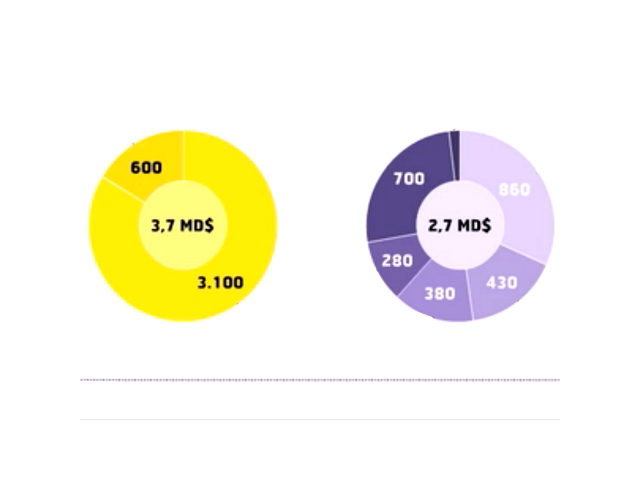
The WashPo treemap is particularly disappointing given that the economy is a favorite playground for infographics and datavisualizations. Further proof of that comes from Frédéric Vuillod’s blog Echosdataviz, which has come up with a very simple and didactic video just in time for Facebook’s IPO. Two criticisms: 18 seconds of pre-advertising (sorry) and the video isn’t embeddable.
DataWorld
The famous World Economic Forum, the military wing of moral capitalism, has offered up a nice (borderline decadent) video to present their 2012 report on the “global risks” that could transform our planet into a veritable torture chamber if world leaders don’t act now to stop them. Our favorite “risks” are undoubtedly “the Seeds of Dystopia” – symbolized by flags, clenched fists and an Anonymous mask – and the “the Dark Side of Connectivity” – represented by a USB port, the real enemy of human fulfillment. Beyond the propaganda, objectively speaking the video is well put together…
DataBowl
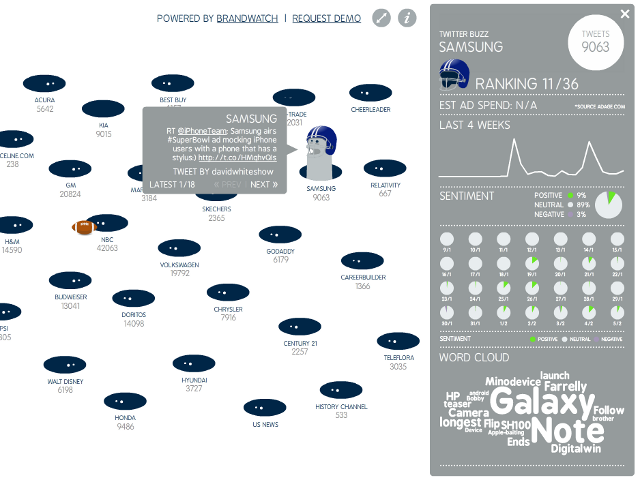
Thankfully, to counteract the anarchists and the hackers, there’s always the Super Bowl. Brandwatch laboratories have created an application (based on Twitter) of the social impact of those advertisers who can afford to pay for a 30 second ad during the annual global TV gathering.
We’ll finish this week with the mandatory video from Stephen Malinowski. Have a great data week!
Find previous editions of The Week In Data!
Follow OWNI’s elite data squadron on Twitter: @pdatha, @gregoirenormand, @mariecoussin, @juliengoetz & @nicolaspatte
💬 Discussion
No comments yet. Be the first to comment!